

Score reels are the electromechanical numeric displays at the heart of every classic EM pinball machine — each one advances exactly one digit position per scoring pulse, driven by a solenoid/plunger, timed by a score motor or scoring relay, and reset to zero at game start by a zero/runout switch. The key components working together are the reel wheel itself, the coil and plunger, a return spring, a pawl or ratchet linkage, and a switch stack that includes the zero/runout switch, position switches for digits 1–9, a 9-to-carry rollover contact, and the end-of-stroke (EOS) switch. Understanding the function of score reels means understanding all of those parts as a system — and that’s exactly what this guide covers, from mechanical operation through diagnostics, repair, and parts sourcing.
Table of Contents
- What is the role of score reels in EM pinball?
- How do score reels handle scoring logic and the player unit?
- How does the reset sequence actually work?
- What are the most common score reel failures and how do you diagnose them?
- How do you repair or replace a score reel assembly?
- What maintenance keeps score reels running reliably?
- Where can you find manuals, repair guides, and authoritative threads?
- Key Takeaways
- Why the EOS switch deserves your attention first
- Premiumpinballs has the parts and machines serious collectors trust
- Useful sources and service pages
What is the role of score reels in EM pinball?
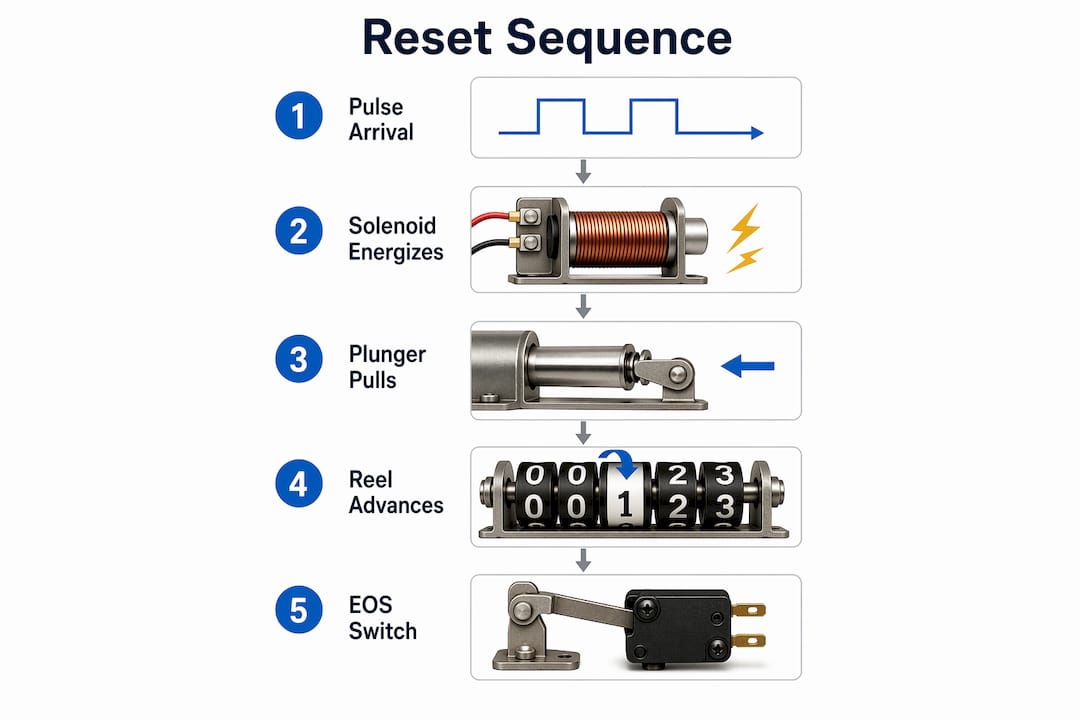
The mechanical indexing is elegantly simple. When a scoring event fires, the score motor or scoring relay sends a single timed pulse to the reel’s solenoid. The solenoid pulls its plunger, which pushes the pawl against the ratchet teeth on the reel wheel, rotating it exactly one position. The return spring then pulls the plunger back, resetting the pawl for the next pulse. One pulse, one digit advance — every time.
The switch stack mounted alongside the reel wheel is what gives the machine its electrical intelligence. Each switch in the stack changes state at a specific reel position:
- Zero/runout switch: signals the reset circuit that the reel has reached zero
- Position switches (1–8): used by various game circuits to track score state
- 9/rollover switch: closes at position 9 to trigger a carry pulse to the next reel
- EOS (end-of-stroke) switch: cuts solenoid power at the end of the plunger stroke to prevent coil burnout
The timing sequence runs like this: a scoring pulse arrives → the solenoid coil energizes → the plunger pulls → the reel advances one step → the EOS switch opens and removes power from the coil → the reel contacts change state for the new position. According to the Williams score reel repair documentation, if the EOS opens too soon the solenoid loses power before completing its stroke; if it fails to open at all, the coil stays energized and can burn. That single switch is responsible for more coil failures than almost any other component on the reel.
Pro Tip: Before you power up a machine with a suspected reel fault, manually actuate the plunger by hand and watch whether the EOS switch opens at the end of the stroke. If it doesn’t open cleanly, cut power immediately — a stuck-closed EOS will destroy the coil within seconds of energizing.
The Visual Pinball Engine documentation on score reel displays offers a useful reference for understanding how these mechanisms are modeled digitally, which can help you visualize the switch-state logic before you open the backglass on a real machine.
How do score reels handle scoring logic and the player unit?
A typical EM machine uses a column of reels per player — units, tens, hundreds, and sometimes thousands — stacked so that a 9-to-0 rollover on the units reel automatically fires a carry pulse to the tens reel. That carry pulse is just another solenoid pulse, triggered by the 9/rollover switch closing as the units reel passes through position 9. The hundreds reel gets its carry the same way from the tens reel. It’s a purely mechanical cascade, and it’s beautiful when it works.
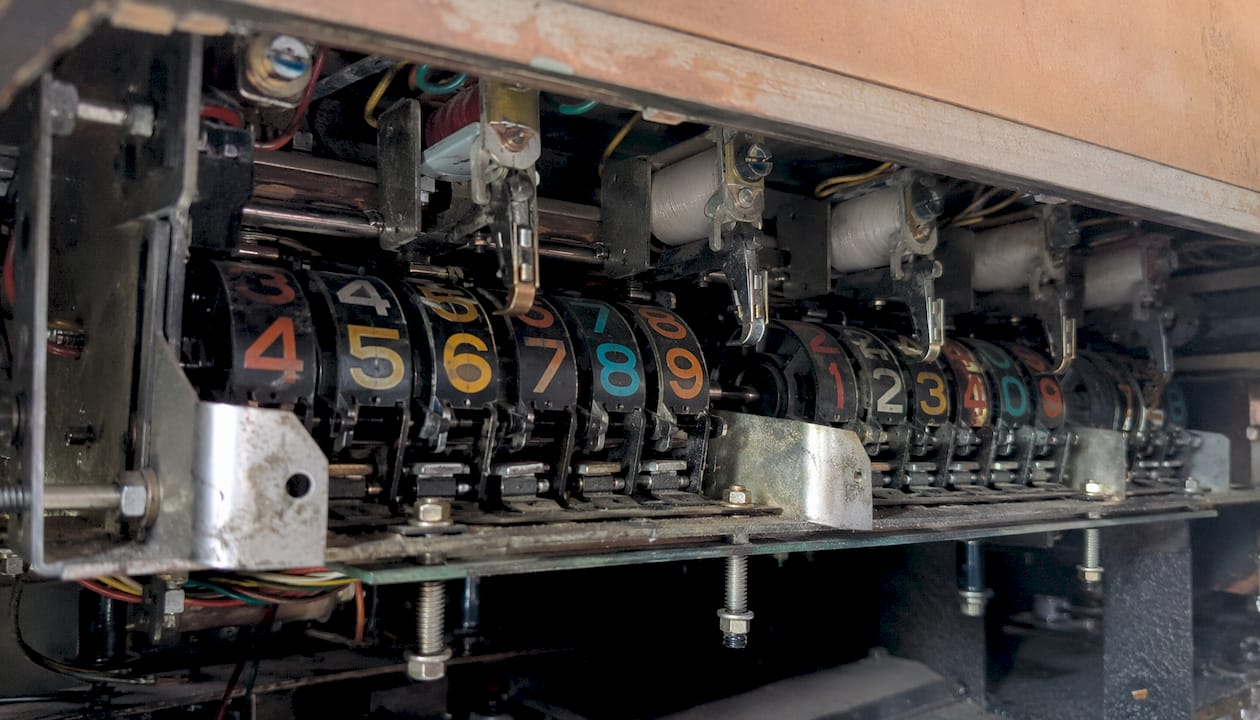
The player unit adds another layer. In a multi-player machine, the player unit is a separate electromechanical assembly that routes scoring pulses only to the active player’s reel set. When the player unit steps to Player 2, it switches the scoring circuit so that all incoming pulses go to Player 2’s reels while Player 1’s reels are locked out. Faults in the player unit can cause scoring to land on the wrong player’s display or prevent the machine from advancing to the next player at all.
When reels misbehave, the gameplay impact is immediate and obvious:
- Ghost scores: a reel advances without a valid scoring event, usually from intermittent contacts or a shorted switch
- Missing carry: the tens reel doesn’t advance when the units reel rolls over from 9 to 0, leaving the score visually wrong
- Stuck in reset: the machine can’t confirm all reels reached zero, so it refuses to enter gameplay — a classic symptom of a failed zero switch
- Wrong player scoring: the player unit misroutes pulses, crediting the wrong reel set
Tracing these faults on a schematic is the fastest path to a fix. The VPE score motor documentation explains how the score motor cam timing coordinates with reel pulses, which is directly applicable to reading the timing diagrams in manufacturer service manuals.
How does the reset sequence actually work?
At game start, every reel must reach zero before play begins. The reset circuit fires the reset coil (or uses the score motor) to send pulses to each reel until its zero/runout switch signals that it has arrived at position 0. Here’s where design variations matter enormously: depending on the manufacturer and production year, the zero switch may be closed at zero or open at zero. Adjusting a switch without confirming which logic your machine uses will break the reset entirely.
A practical reset verification checklist:
- Power off the machine and open the backglass to access the reel cage.
- Visually confirm each reel reads 0 — if any reel shows a non-zero digit, the reset sequence isn’t completing.
- Check zero switch continuity with a voltmeter or continuity tester: place the reel manually at position 0 and verify the switch state matches what your schematic specifies (open or closed).
- Manually advance each reel one position away from zero, then release it and re-check the switch — it should change state cleanly.
- Run a reset cycle with the backglass open and watch each reel return to zero; any reel that stops short or overshoots has a switch or coil problem.
As a Pinside forum thread on score reel switch logic notes, Gottlieb designs after roughly 1973 converged on a more consistent switch stack, but earlier games vary — always verify against the schematic before touching a switch. The PinWiki EM Repair switch-state tables provide position-by-position open/closed maps for common reel designs and are an indispensable reference when you’re adjusting contacts.
What are the most common score reel failures and how do you diagnose them?
Most reel faults trace back to four root causes: dirty or burned contacts, a weak or broken return spring, a bent reel basket or backwards latch, and EOS switch problems. The Gottlieb decagon repair guide notes that decagon reels use redundant contacts on some switches, and a single failed contact can still cause intermittent faults even when the backup contact appears functional.
Work through this diagnostic sequence before replacing anything:
- Safety first: power off and discharge capacitors before touching any reel assembly
- Visual inspection: look for bent switch leaves, cracked reel faces, a stuck pawl, or a deformed backwards latch preventing rotation
- Manual plunger test: actuate the plunger by hand and confirm the reel advances one clean step and the EOS opens at stroke end
- Continuity check: use an ohmmeter on the coil terminals — a healthy reel coil shows continuity; an open reading means a burned coil
- Switch-state verification: with the reel at each position, probe the switch stack contacts and compare to the manufacturer’s switch-state table
- Timed reset observation: restore power briefly and watch the reset cycle with the backglass open, noting which reel stalls or overshoots
For coil resistance, the Williams reel repair guide confirms that bench-testing involves measuring coil ohms, manually actuating the plunger to observe the full switch sequence, and checking that the reel basket latch isn’t bent and blocking rotation.
Pro Tip: To safely observe switch state changes during a live reset, clip a small alligator-lead test light across the zero switch terminals before powering on. The light tells you the moment the switch changes state without requiring you to probe live contacts — far safer than poking around with a meter while the reset motor is running.
How do you repair or replace a score reel assembly?
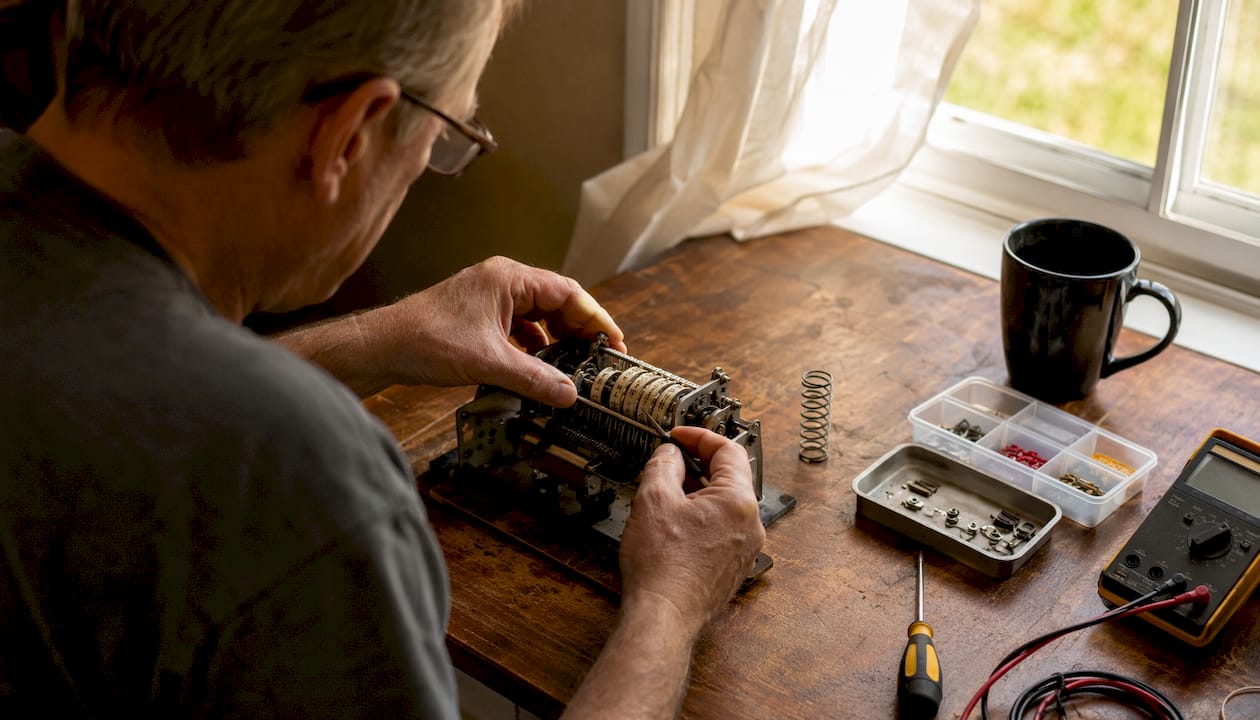
A typical bench repair follows this sequence: remove the reel cage from the backglass, clean all switch contacts, inspect and replace any broken springs or worn pawl clips, reassemble, bench-test the coil and switch sequence, reinstall, and run a full reset cycle to confirm. The Dogford Studios EM score reel repair guide is one of the most thorough step-by-step references available and includes photos of each stage.
Parts and tools you’ll want on hand:
- Replacement parts: switch contact blades, return springs, pawl clips, EOS switch assemblies, and reel face decals if the originals are damaged
- Tools: digital ohmmeter, switch adjusting tool (a small flat-blade or dedicated pinball switch tool), snap ring pliers for reel cage disassembly, and a bright work light
- Sourcing: specialist pinball parts suppliers carry most of these; small contact and spring parts typically run $5–$40 depending on the part and reel design, while full replacement assemblies or NOS (new-old-stock) reels cost considerably more and may have longer lead times
For a simple contact cleaning and spring replacement, budget 30–90 minutes per reel. A full reel replacement, including sourcing and bench-testing, takes longer and the cost of a complete assembly may make it worth evaluating whether a refurbished machine is a smarter investment than sinking hours into a heavily worn reel set.
Two safety notes worth keeping front of mind: never over-lubricate. The Williams cleaning guide specifies that light Teflon lubricant belongs only on metal-to-metal contact surfaces — nylon plungers and linkages should stay dry because lubricant causes them to attract debris and bind. And be careful with reel face cleaning: the printed digits use delicate ink that harsh solvents will strip. Clean around the numbers with a Q-tip and mild soapy water or isopropyl alcohol, testing a small area first.
Pro Tip: If a reel face has already lost some digit clarity, a replacement decal set is far cheaper than a full NOS reel — and it restores the display to a crisp, readable condition that makes the whole backglass look restored.
What maintenance keeps score reels running reliably?
Preventive care is straightforward and pays dividends in avoided repairs. A few focused habits will keep reels advancing cleanly for years.
- Clean contacts regularly: use a Q-tip lightly dampened with isopropyl alcohol on switch contact surfaces; never soak the assembly or use abrasive cleaners near the reel face
- Inspect switch leaf alignment: leaves that are bent out of spec cause intermittent contacts and mis-indexing; check alignment visually and with a continuity tester at each position
- Check the reel basket latch: a bent backwards latch is a common cause of reels that advance two steps or spin freely; inspect it during every service
- Lubricate sparingly: metal pivot points on the pawl linkage can receive a tiny amount of appropriate lubricant, but keep it away from nylon parts and contact surfaces entirely
- Service intervals: for home play, a full reel inspection every two to three years is reasonable; location machines in commercial use benefit from annual contact cleaning and switch checks
Adding a quick reel visual to your routine maintenance checklist — just confirming all reels zero correctly at game start — catches developing faults before they strand a game mid-play. For a broader view of pinball machine parts and how the reel assembly fits into the full cabinet, that reference is worth bookmarking.
Where can you find manuals, repair guides, and authoritative threads?
The best resources are model-specific, and matching your machine’s manufacturer and production year before adjusting anything is the single most important habit to build.
- Williams 5" Score Reel Cleaning & Repair: detailed step-by-step with photos, lubrication guidance, and bench-test procedure for Williams reel designs
- Gottlieb Decagon Score Reel Repair: covers the decagon’s unique switch stack, redundant contacts, and common failure points specific to Gottlieb machines
- Dogford Studios EM Score Reel Repair Guide: excellent for step-by-step photos and reel face cleaning technique
- PinWiki EM Repair — Score Reel Switch States: the go-to reference for switch-state tables across positions 0–9; use this alongside your schematic when adjusting contacts
- Pinside score reel switch thread: community diagnostics with real-machine examples, particularly useful for pre-1973 Gottlieb designs where switch polarity varies
- VPE Score Reel Documentation: helpful for visualizing the logic model before working on the physical machine
For wiring logic, always pull the manufacturer’s original service manual for your specific model from IPDB or your machine’s documentation packet. Schematics from a different production run of the same title can have different switch polarities — a detail that has sent more than a few hobbyists chasing phantom faults.
Key Takeaways
Score reels are the electromechanical scoring displays that advance one digit per pulse, carry across reel columns, and must zero completely before every game — making the EOS switch and zero/runout switch the two most critical components to verify first.
| Point | Details |
|---|---|
| Core function | Each reel advances one digit per solenoid pulse, timed by a score motor and stopped by the EOS switch. |
| Zero switch logic varies | Always check the schematic before adjusting — the zero switch may be open or closed at position 0 depending on manufacturer and year. |
| EOS failure is the top coil killer | A stuck-closed EOS keeps the solenoid energized and burns the coil; verify EOS operation before powering up a suspect machine. |
| Repair vs. replace threshold | Simple contact and spring repairs run 30–90 minutes and $5–$40 in parts; full assembly replacement costs more and may justify sourcing a refurbished machine. |
| Premiumpinballs for next steps | Premiumpinballs carries refurbished machines and can help hobbyists evaluate whether repair or replacement is the smarter path for their machine. |
Why the EOS switch deserves your attention first
Most hobbyists walk up to a misbehaving reel and start cleaning contacts. That’s not wrong, but it’s often the second thing to do, not the first. The EOS switch is the component that protects the coil from burning, and it’s also the component most likely to be misadjusted after a previous repair attempt. A machine that came through someone else’s hands before yours may have a perfectly clean contact surface sitting next to an EOS that was bent slightly out of spec — and that misadjusted EOS will destroy a new coil just as efficiently as it destroyed the old one.
The other thing that surprises even experienced hobbyists is how much Gottlieb decagon reels differ from Williams designs. The decagon’s redundant switch contacts look like a safety net, but they create a diagnostic trap: one contact fails intermittently, the backup contact keeps the machine running most of the time, and the fault only shows up under specific conditions. Checking both contacts on every redundant switch, not just the one that’s obviously dirty, is the move that saves a second service call.
Finally, if a reel face has lost its printed digits to a previous cleaning attempt, don’t let that push you toward a full NOS reel purchase before you’ve explored decal options. And if the reel cage itself is cracked or the basket is deformed beyond adjustment, that’s the moment to honestly evaluate pinball machine value against the cost of a replacement assembly or a professionally refurbished machine.
Premiumpinballs has the parts and machines serious collectors trust
When a score reel repair turns into a full machine evaluation, Premiumpinballs is the resource serious hobbyists and collectors reach for. The inventory spans refurbished, used, and new machines from the most sought-after titles in the hobby, each listed with detailed specs, transparent pricing, and warranty coverage that gives you confidence whether you’re buying a replacement machine or comparing repair costs against a known-good alternative.

For hobbyists who’ve done the math and decided that a professionally refurbished pinball machine is the smarter investment over a costly reel overhaul, Premiumpinballs offers flexible payment options, shipping and delivery across the United States, and in-store pickup for buyers who want to inspect before committing. Browse the current inventory at premiumpinballs.com and reach out to the team directly for guidance on which machine fits your space, budget, and collector goals.
Useful sources and service pages
Match your machine’s manufacturer and production year before consulting any of these resources, and always cross-reference with your original service manual schematic.
- Williams 5" Score Reel Cleaning & Repairing: step-by-step repair with lubrication and bench-test guidance for Williams reel designs
- Gottlieb Decagon Score Reel Repair and Cleaning: decagon-specific switch stack, redundant contacts, and common failure modes
- EM Score Reels — Williams (switch and EOS detail): EOS timing, coil continuity testing, and switch-state behavior
- Dogford Studios EM Pinball Score Reel Repair Guide: photo-rich step-by-step with reel face cleaning technique
- PinWiki EM Repair — Score Reel Switch States: switch-state tables for positions 0–9 across common reel designs
- Pinside — Score Reel Switch Questions thread: community diagnostics, especially for pre-1973 Gottlieb switch polarity variations
- VPE Score Reel Displays documentation: logic model reference useful for understanding switch-state behavior before opening the backglass