
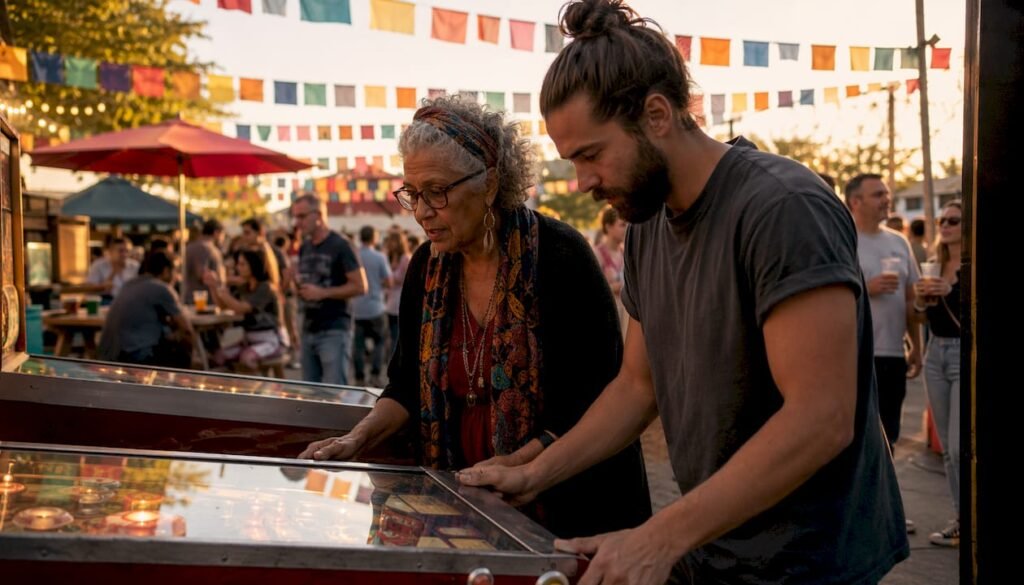
Pinball is one of the most compelling forms of event entertainment in the United States, and its role in gatherings goes far beyond simple amusement. Whether you’re planning a corporate celebration, a neighborhood festival, or a competitive tournament, a well-placed pinball machine transforms passive attendees into active, engaged participants. The game’s unique blend of skill, spectacle, and nostalgia makes it a natural centerpiece for any social occasion, drawing players and spectators alike into a shared experience that sparks conversation and friendly rivalry. Few entertainment formats can claim that kind of magnetic pull across generations.
Here is a quick look at the core roles pinball plays in events today:
- Social catalyst: Pinball creates an immediate focal point, giving strangers a reason to interact and compete.
- Skill-based competition: Tournaments and head-to-head play add structured excitement to festivals, fairs, and conventions.
- Nostalgic anchor: The sights and sounds of a pinball machine evoke powerful memories, connecting older and younger guests.
- Crowd engagement tool: Free-play setups keep guests entertained for hours without requiring staff facilitation.
- Cultural statement: A premium machine signals taste, prestige, and a commitment to exceptional event programming.
- Revenue driver: Coin-operated or ticketed play generates income at fairs, barcades, and sponsored events.
How did pinball evolve into a cultural phenomenon in America?
Pinball’s origins trace back to the 18th-century French parlor game bagatelle, but the machine as Americans know it is a distinctly American invention of the 1930s. Early versions were simple tabletop devices with no flippers, relying almost entirely on the plunger and the luck of the ball’s path. The game spread quickly through arcades, bars, and corner stores, becoming a fixture of working-class leisure culture during the Great Depression.
The history of pinball machines is inseparable from controversy. Mayor Fiorello LaGuardia of New York City launched a very public war against pinball in the 1930s, characterizing machines as “insidious nickel-stealers” operated under the influence of organized crime. His 1934 election campaign promised to root out corruption, and pinball became a symbol of that crusade. Other major U.S. cities began enacting their own bans starting in 1936, dealing a severe blow to the industry and cementing pinball’s reputation as a morally suspect pastime for decades.
The game’s rehabilitation began with a single mechanical innovation. In 1947, Gottlieb introduced player-operated flippers with Humpty Dumpty, fundamentally shifting pinball from a game of chance to one demanding genuine skill. That design change gave manufacturers a credible argument against gambling classifications and opened new markets. Gottlieb’s 1960 Add-a-Ball mechanic, engineered by Wayne Neyens, further sidestepped local bans by rewarding skilled play with extra turns rather than cash or free games.
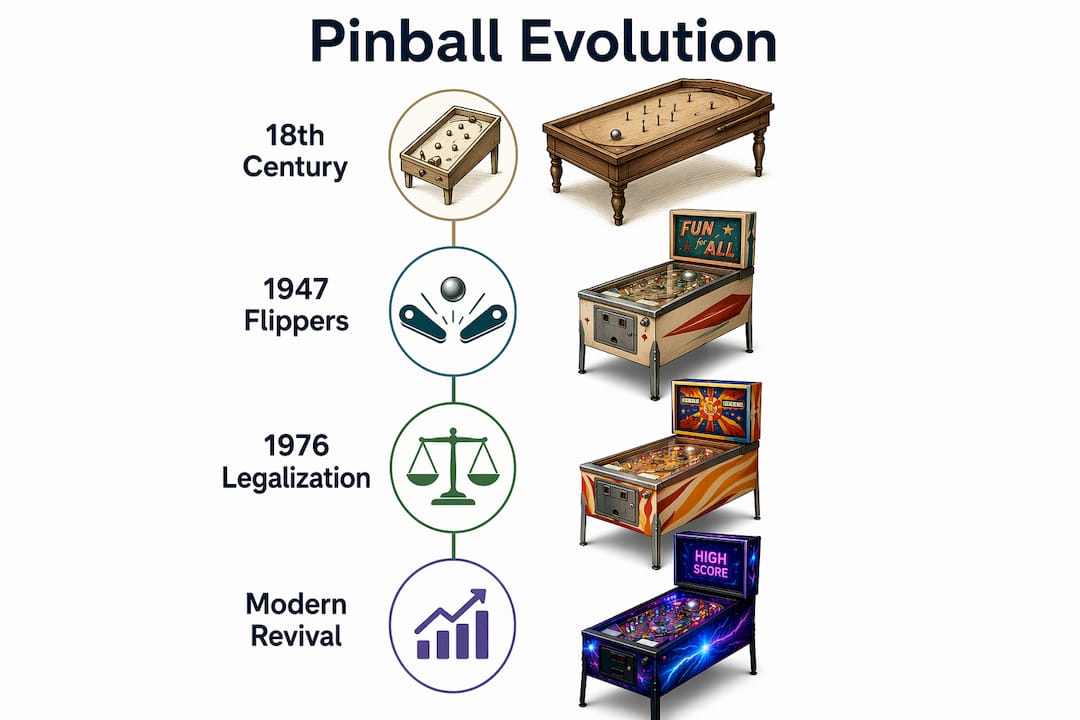
The pivotal legal moment arrived in 1976, when journalist and top-ranked player Roger Sharpe) appeared before the New York City Council and demonstrated, through live play, that pinball required measurable skill. His testimony convinced the council to lift the city’s decades-long ban. Chicago followed in 1977, and the industry approached its strongest commercial peak since the 1930s.
Major milestones in American pinball history:
| Year | Event |
|---|---|
| 1930s | First commercial pinball machines spread through U.S. arcades and bars |
| 1934 | Mayor LaGuardia launches anti-pinball campaign in New York City |
| 1936 | Major U.S. cities begin enacting pinball bans |
| 1947 | Gottlieb’s Humpty Dumpty introduces player-operated flippers |
| 1960 | Gottlieb’s Add-a-Ball mechanic creates new legal workaround |
| 1976 | Roger Sharpe’s NYC Council testimony leads to legalization |
| 1977 | Chicago lifts its pinball ban following New York’s lead |
- Early machines had no flippers; skill was limited to the plunger and machine nudging.
- Bally produced the first automatic payout machine, Rocket, in 1933, deepening gambling associations.
- The Johnson Act eventually classified certain payout machines as gambling devices at the federal level.
- Microprocessors entered pinball design in the late 1970s, opening the door to complex rules and digital scoring.
- The Strong National Museum of Play now maintains a permanent Pinball Playfields exhibit, recognizing pinball as a part of American cultural history.
How does pinball build community and social bonds at gatherings?
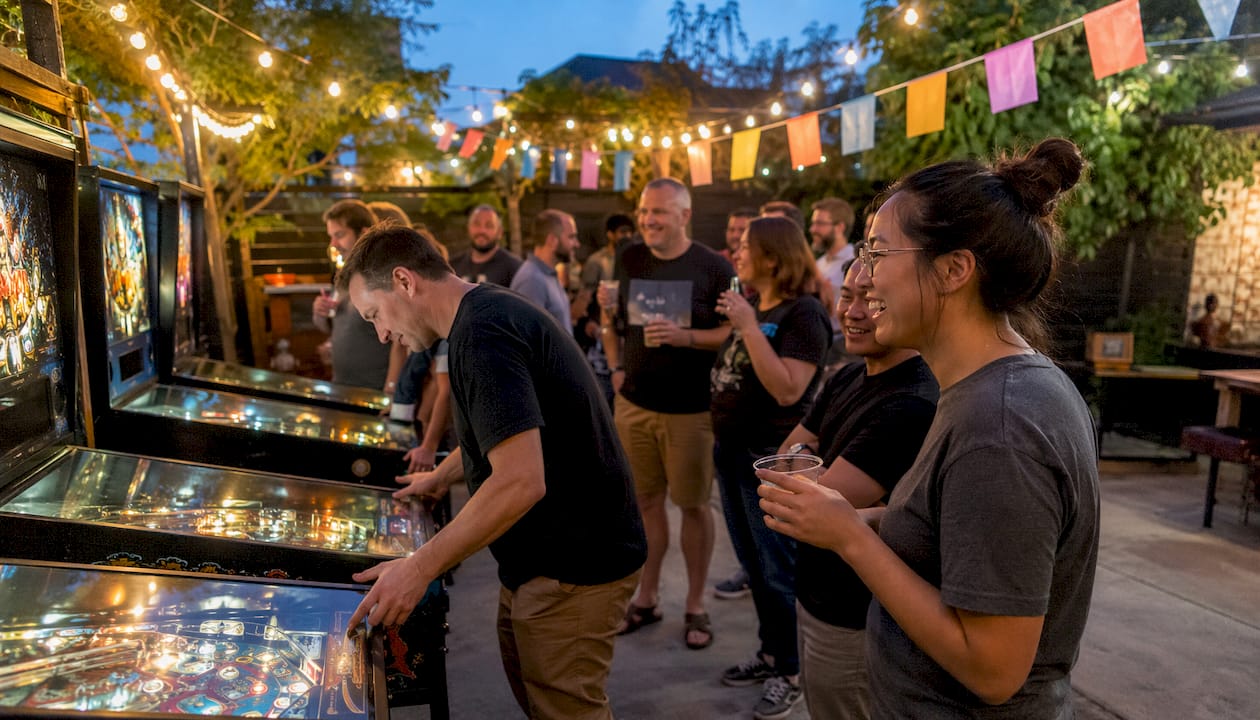
Pinball’s power as a social tool at events is well documented and deeply felt. The machine creates what sociologists call a “third space,” a neutral ground separate from home and work where people gather, interact, and form connections around a shared activity. At parties, festivals, and conventions, a pinball machine draws a natural crowd, with players and onlookers forming an impromptu community around the cabinet.
Pinball machines challenge players cognitively and socially, creating rich, multisensory shared experiences that unite diverse event attendees. The game’s combination of strategy, quick reaction, and sensory stimulation makes it one of the most socially engaging activities available at any gathering.
The growth of organized pinball leagues across the United States tells a compelling story about the game’s community-building capacity. Modern pinball leagues now report over 40% female participation, a figure that reflects how far the culture has moved from its male-dominated arcade roots. Leagues operate in bars, barcades, and community centers, providing a structured social outlet that welcomes players of every skill level and background.
Event operator Durivage, who runs pinball-focused event spaces in Montreal, has observed a clear shift in what guests want from a night out. Rather than passive drinking, attendees increasingly seek active social experiences, and pinball sits at the center of that shift. Durivage’s approach prioritizes the machine as a conversation anchor, a place where strangers become competitors and competitors become friends.
Here is how pinball builds community across different event formats:
- Casual parties: A single machine in free-play mode becomes the most visited spot in the room, generating organic conversation and laughter.
- Corporate events: Head-to-head play breaks down professional hierarchies and creates memorable shared moments between colleagues.
- Festivals and fairs: Multiple machines arranged in a dedicated zone create a destination within the event, extending dwell time.
- Competitive tournaments: Structured brackets and leaderboards give participants a reason to return, building loyalty and repeat attendance.
- Conventions: Themed machines tied to pop culture properties attract fans and collectors, deepening the event’s identity.
The demographic diversity within pinball communities today is one of the game’s greatest assets for event planners. Families, retirees, competitive players, and casual guests all find something to love in a well-chosen machine, making pinball one of the few entertainment formats that genuinely works for mixed-age, mixed-background crowds.
How has pinball appeared in film, television, music, and art?
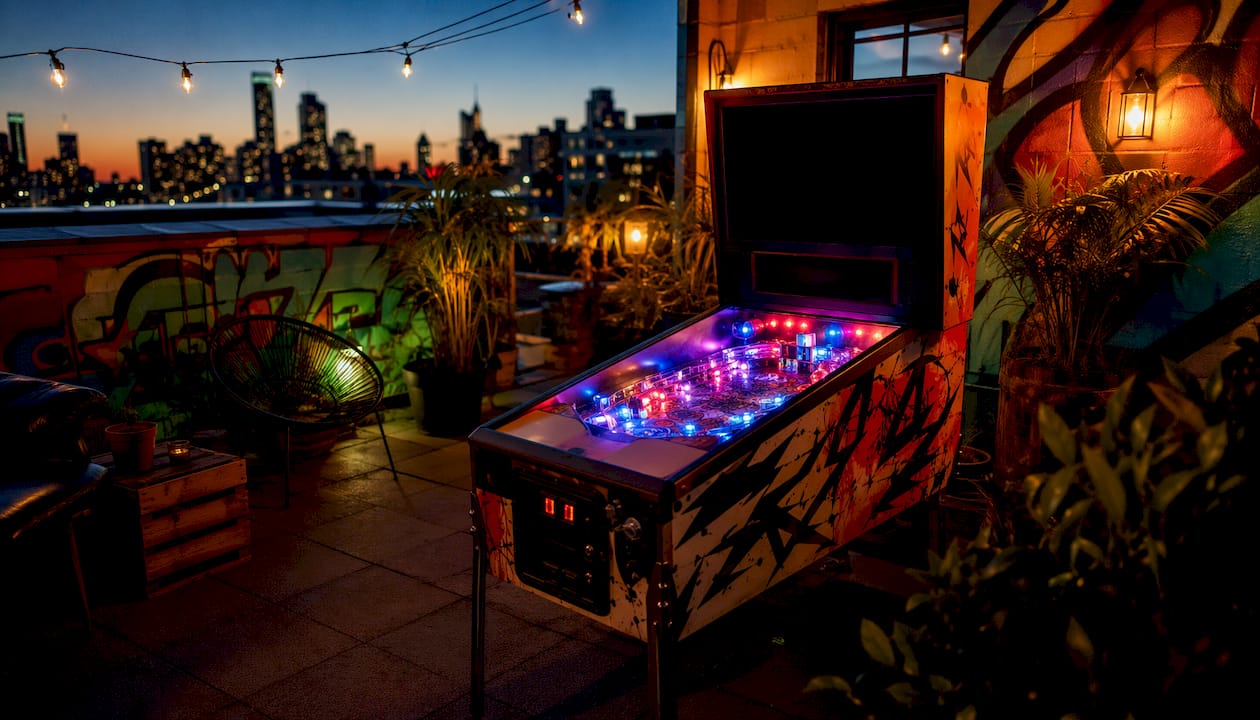
Pinball’s cultural footprint extends well beyond the arcade. The game has appeared in some of the most celebrated works of American and British popular culture, cementing its status as a symbol of rebellion, youth, and electric energy.
The most iconic musical treatment of pinball is The Who’s 1969 rock opera Tommy, which centers on a “deaf, dumb, and blind” boy who becomes a pinball wizard of almost supernatural ability. The song “Pinball Wizard” became one of rock’s defining anthems, and the 1975 film adaptation brought the imagery of flashing machines and frenzied play to a mass cinema audience. That single work did more to embed pinball in the cultural imagination than any advertising campaign could have managed.
“Pinball Wizard” transformed the machine from a corner-store fixture into a mythic object, a symbol of intuition, mastery, and counterculture cool. The image of a player locked in silent communion with a roaring cabinet captured something that words alone rarely achieve.
Television has returned to pinball repeatedly as a shorthand for nostalgia and Americana. Happy Days, set in the 1950s, featured pinball as a staple of the Cunningham family’s world, reinforcing the machine’s association with postwar youth culture. More recently, shows like Stranger Things have used arcade settings, including pinball machines, to evoke the specific texture of 1980s American childhood.
In visual art, pinball machines have attracted serious attention as objects of design excellence. The hand-painted backglasses and playfield artwork of machines from the 1950s through the 1980s are now collected and exhibited as examples of American commercial illustration at its most vivid. Museums including The Strong National Museum of Play hold original Williams Pinball Playfields Design Collection drawings, treating them as legitimate artifacts of graphic art history.
Key moments of pinball in popular culture:
- Tommy (1969/1975): The Who’s rock opera and Ken Russell’s film adaptation made “Pinball Wizard” a global anthem.
- Happy Days (1974–1984): Pinball as a recurring symbol of 1950s American youth culture on network television.
- Tilt (1979): A feature film centered entirely on competitive pinball, reflecting the game’s late-1970s commercial peak.
- Stranger Things (2016–present): Arcade and pinball imagery used to anchor the show’s 1980s setting and emotional nostalgia.
- Backglass art collections: Original machine artwork now held in museum collections as examples of American commercial illustration.
How did pinball shift from a gambling stigma to a recognized skill game?
The transformation of pinball’s legal and cultural status is one of the more remarkable rehabilitation stories in American entertainment history. For roughly four decades, the game was classified alongside slot machines and dice games in cities across the country, banned outright in New York City from 1942 until 1976.
The gambling stigma attached to pinball had two main sources. First, early machines often delivered cash payouts or prizes, making them functionally indistinguishable from slot machines in the eyes of legislators. Second, critics argued that the ball’s path was essentially random, meaning players exercised no meaningful control over outcomes. Both arguments held some truth for the earliest machines, but became increasingly strained as game design evolved.
Gottlieb’s introduction of flippers in 1947’s Humpty Dumpty was the first decisive rebuttal to the “game of chance” argument. Flippers gave players direct, repeatable control over the ball’s trajectory, creating a skill ceiling that separated novices from experts in ways that slot machines never could. The 1960 Add-a-Ball format reinforced this by rewarding skilled play with extended gameplay rather than cash, further distancing pinball from gambling mechanics.
| Decade | Key shift |
|---|---|
| 1930s | Cash payout machines dominate; gambling associations solidify |
| 1940s | Flippers introduced; skill argument gains credibility |
| 1950s–60s | Bingo machines revive gambling concerns; Add-a-Ball offers legal workaround |
| 1970s | Roger Sharpe’s 1976 testimony triggers NYC legalization |
| 1980s onward | Pinball widely recognized as a skill game; bans lifted across U.S. cities |
Roger Sharpe’s 1976 appearance before the New York City Council remains the single most consequential moment in pinball’s legal history. Sharpe, then a journalist and one of the country’s top-ranked players, called his shots in advance during a live demonstration, proving that the game rewarded intention and skill rather than chance. The council voted to legalize pinball, ending a 34-year prohibition in the country’s largest city.
Pro Tip: If you’re incorporating pinball into a competitive event format, framing the game explicitly as a skill competition, with brackets, handicaps for beginners, and public leaderboards, reinforces the game’s legitimate, prestigious status and attracts a wider range of participants.
The cultural shift that followed legalization was swift. Pinball shed its association with vice and reclaimed its place as mainstream entertainment, arriving at its commercial peak in the late 1970s and early 1980s. The evolution of pinball features from simple plungers to complex multiball ramps and digital scoring systems mirrored the game’s growing respectability as a test of genuine ability.
What is driving the modern renaissance of pinball at events?
Pinball’s contemporary revival is powered by two forces working in tandem: a cultural hunger for tactile, analog experiences in a screen-saturated world, and a new generation of venues that understand the game’s social value. Barcades, the hybrid bar-and-arcade concept that spread across American cities through the 2010s, placed pinball at the center of a new kind of nightlife, one built around active play rather than passive consumption.
The resurgence of pinball in public venues reflects a broader shift in how Americans want to spend leisure time. Guests at barcades and event spaces are not simply looking for a drink; they want an experience they can share, photograph, and talk about afterward. A majestic, fully restored classic machine or a modern Stern Pinball title with licensed artwork delivers exactly that kind of memorable moment.
Technology has played a significant role in making modern pinball more compelling for event settings. Today’s machines feature LED light shows, surround sound, high-definition LCD displays, and rule sets of extraordinary complexity. Stern Pinball’s Game of Thrones machine, for example, allows players to choose a “house” with unique gameplay attributes, creating a personalized experience that rewards repeated play. These advances make new pinball technology a genuine draw for event programmers seeking entertainment that holds attention across an entire evening.
Modern pinball events take several distinct forms, each with its own appeal:
- Barcade nights: Venues dedicate floor space to multiple machines in free-play mode, creating an all-inclusive social environment.
- Pop-up tournaments: Organized by leagues affiliated with the International Flipper Pinball Association (IFPA), these events draw competitive players to bars, breweries, and convention halls.
- Festival installations: Outdoor and indoor festivals feature pinball zones as destination attractions within larger programming.
- Corporate activations: Branded or themed machines appear at product launches and company celebrations as prestige entertainment pieces.
- Charity tournaments: Pinball competitions raise funds for nonprofits, combining competitive excitement with community purpose.
The multigenerational appeal of pinball makes it uniquely valuable for event programmers. A 70-year-old who played Fireball in a 1970s bowling alley and a 25-year-old discovering pinball for the first time at a barcade can share the same machine, the same excitement, and the same conversation. That kind of cross-generational connection is rare in entertainment, and it is one of the reasons event planners continue to reach for pinball as a programming anchor.
Numbered steps for incorporating pinball into a modern event:
- Define the format: Decide between free-play, coin-operated, or tournament-style play based on your event’s goals and audience.
- Select the right machines: Match the machine’s theme and difficulty to your crowd. Licensed titles like Ghostbusters or Addams Family carry instant recognition.
- Plan the physical setup: Account for power requirements, door clearance, and level flooring before the event day.
- Promote the experience: Feature the machines in your event marketing to attract guests who value interactive entertainment.
- Arrange technical support: Confirm that your vendor provides on-site support to address any mechanical issues without disrupting the event’s flow.
What makes pinball a uniquely powerful social tool in U.S. events today?
Pinball occupies a rare position in the event entertainment world. It is simultaneously a competitive sport, a nostalgic artifact, and an accessible icebreaker, qualities that few other entertainment formats combine in a single cabinet. Event planners who understand this layered appeal consistently report that pinball machines generate more organic social interaction than almost any other activity they offer.
Successful modern events focus on social activities rather than passive drinking, with pinball providing an accessible icebreaker and shared focus. Event operator Durivage describes the machine as a “social activity anchor” that gives guests a reason to gather, compete, and connect without the awkwardness of forced mingling.
The “third space” quality of pinball at events is worth understanding in practical terms. When a machine sits in the corner of a party venue, it does not simply entertain the person playing it. It draws a ring of observers, generates commentary, invites challenges, and creates a natural social hierarchy of skill that everyone can participate in, whether as a player, a coach, or an enthusiastic spectator. That dynamic is difficult to replicate with passive entertainment like a DJ or a photo slideshow.
The over 40% female participation in modern pinball leagues signals a demographic shift that event planners should take seriously. Pinball is no longer a game that appeals primarily to a narrow slice of the population. Thoughtful machine selection, welcoming free-play formats, and inclusive tournament structures have opened the game to a genuinely diverse audience, making it a strong fit for events that prioritize broad engagement.
Logistics matter as much as machine selection when using pinball for events. Reliable vendors supply commercial-grade machines with on-site technical support, because even a brief mechanical failure can break the social momentum a machine has built. Power requirements, door dimensions, and floor levelness all need advance attention. For event planners new to pinball logistics, resources on how to move a pinball machine provide practical guidance on safe transport and setup.
Pinball also generates measurable economic value at events. Coin-operated machines produce direct revenue, while free-play setups extend guest dwell time and increase food and beverage spending. Sponsored or branded machines at corporate events carry marketing value that extends beyond the event itself through social media sharing. For venues considering a permanent installation, the revenue and engagement benefits of a well-chosen machine can justify the investment within a single season.
Bring the Prestige of Pinball to Your Next Event
There is no entertainment centerpiece quite like a premium pinball machine. Whether you are curating a private celebration, a corporate activation, or a public festival, the right machine transforms the atmosphere and gives your guests something genuinely memorable to rally around. At Premiumpinballs, we offer an exceptional selection of refurbished, used, and new machines, from iconic classics like Addams Family and Attack From Mars to the latest Stern Pinball titles, each one ready to become the statement piece your event deserves.
Explore our curated collection of event-ready pinball machines and find the machine that matches your vision. For those seeking the best of the current market, our top machines for 2025 page showcases the titles generating the most excitement among collectors and event planners alike. If you want to understand how pinball fits into the broader world of party entertainment options, the possibilities are wider than most event planners realize.
Every machine we sell comes backed by our commitment to quality, warranty coverage, and dedicated customer support. Reach out to our team today and let us help you select the perfect machine for your next extraordinary event.
Key Takeaways
Pinball’s role in events is most powerful when it functions as a social anchor, a skill-based competition, and a cultural statement piece simultaneously, making it one of the most versatile entertainment investments available to event planners.
| Point | Details |
|---|---|
| Social catalyst at events | Pinball creates organic interaction, drawing players and spectators into shared, conversation-rich experiences. |
| Over 40% female participation in modern pinball leagues | Modern pinball communities are genuinely diverse, making the game a strong fit for inclusive event programming. |
| Skill game since 1976 | Roger Sharpe’s NYC Council testimony ended decades of bans and established pinball’s legal status as a skill-based game, following his 1976 demonstration. |
| Logistics require advance planning | Power needs, door clearance, floor levelness, and on-site tech support all determine whether a pinball event runs smoothly. |
| Revenue and engagement benefits | Pinball extends guest dwell time, drives food and beverage spending, and generates direct coin-operated or ticketed revenue. |