

What the US pinball market looks like heading into 2026
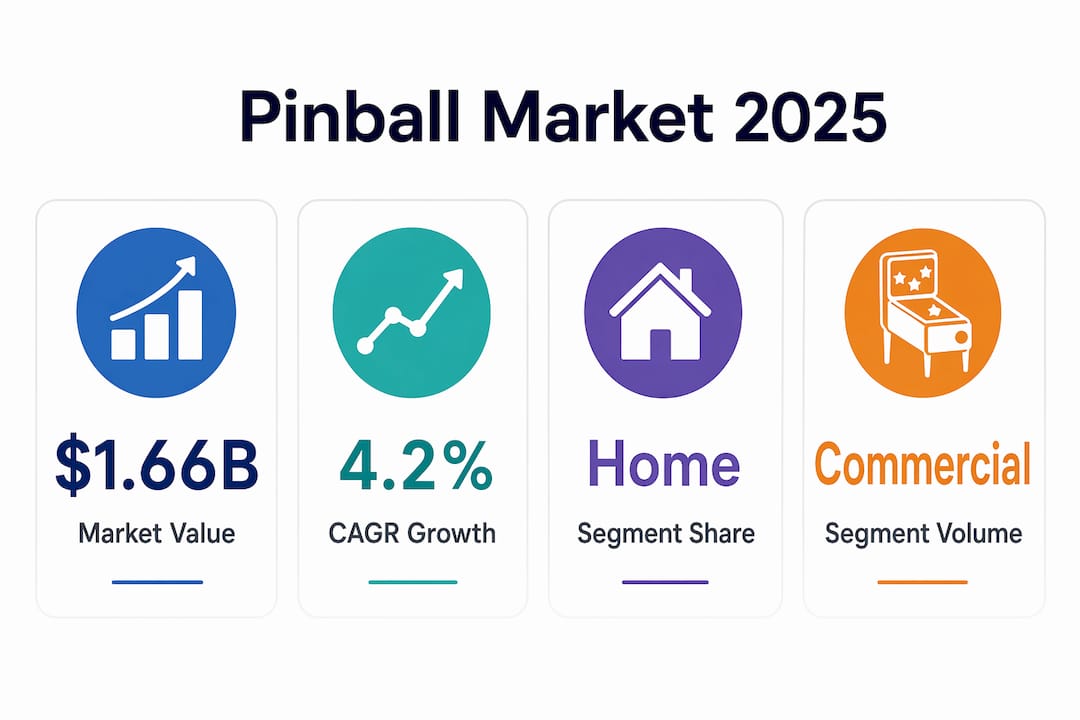
The global pinball machine market is valued at approximately $1.66 billion in 2025, projected to grow at a CAGR of 4.2% through 2035. That steady, compounding trajectory reflects something deeper than nostalgia: it signals a maturing collector economy, a thriving venue culture, and a product category that has proven its staying power across economic cycles.
Pinball market trends 2025 are shaped by three converging forces: the retro gaming renaissance, accelerating technological integration in machine design, and the explosive growth of experiential entertainment venues. Prices, after surging dramatically in the early 2020s, have settled into a more sustainable pattern, with used machine prices rising 31% in 2021, 21% in 2022, and then moderating to 5% in 2023. That stabilization is healthy for the market’s long-term credibility.
Key signals for analysts and operators to track through 2025:
- Market size: Approximately $1.66 billion globally, with North America holding the dominant regional share
- Growth rate: 4.2% CAGR projected through 2035, driven by retro gaming demand and venue expansion
- Pricing trajectory: Post-pandemic price spikes have cooled; the market rewards quality and title reputation over speculation
- Collector demand: Premium and licensed machines continue to command prestige pricing, with affluent buyers driving the high end
- Technology influence: LCD displays, digital scoring, and interactive playfield elements are now standard expectations in new machines
For investors and commercial operators, the 2025 pinball industry forecast points to a market that rewards precision: the right titles, the right condition, and the right venue context.
Table of Contents
- What drives growth and what holds the US pinball market back
- How the US pinball market breaks down by type and application
- Which US regions offer the strongest pinball investment opportunities
- Who shapes the US pinball industry and what they are doing in 2026
- Where the real investment opportunities sit in the 2025 pinball market
- How collector behavior shapes demand, pricing, and market dynamics
- What operators and investors need to know about regulatory compliance
- Who is actually buying pinball machines and why it matters for the market
- Key Takeaways
- Explore the machines driving the 2025 market with Premiumpinballs
What drives growth and what holds the US pinball market back
Understanding the forces behind the 2025 pinball sales predictions requires separating genuine structural drivers from cyclical noise. The US market has both compelling tailwinds and real friction points that any serious operator or investor must account for.
Growth drivers:
- Nostalgia and retro culture: The barcade movement has transformed pinball from a relic into a centerpiece. Around 40% of new entertainment venues in North America feature pinball machines, a figure that reflects how deeply the format has embedded itself in experiential hospitality.
- Licensed themes: Titles tied to beloved franchises — from classic rock bands to blockbuster films — generate immediate consumer recognition and sustained demand. Licensing is now a primary competitive weapon among manufacturers.
- Technological advances: Modern machines with multi-level playfields, integrated video displays, and networked scoring systems appeal to a generation raised on digital gaming. These features justify premium price points and attract a broader demographic.
- Rising disposable income among target demographics: Affluent collectors and entertainment entrepreneurs are actively seeking prestige acquisitions, and a well-specified pinball machine fits that profile elegantly.
Market restraints:
- High entry-level pricing: New machines from premium manufacturers often command high price points that limit impulse purchasing and narrow the addressable buyer pool. That price point limits impulse purchasing and narrows the addressable buyer pool.
- Supply chain complexity: Component sourcing for electronics, custom playfield artwork, and specialty hardware remains vulnerable to disruption, affecting production timelines and machine availability.
- Demographic concentration: The core enthusiast base skews toward buyers aged 35–60, creating a long-term succession challenge as the market works to attract younger players.
Opportunities:
- Hybrid digital-traditional machine designs that bridge the gap between video gaming and physical play
- Customization and bespoke theming for high-end residential and hospitality clients
- Venue partnership models where operators share revenue with entertainment destinations
How the US pinball market breaks down by type and application
The US pinball market is meaningfully segmented, and where you place your investment capital or purchasing budget depends entirely on which segment aligns with your operational goals. The table below maps the primary divisions.

| Segment | Description | Growth Outlook | Primary Buyers |
|---|---|---|---|
| New machines (wired) | Traditional hardwired machines from major manufacturers | Steady; driven by venue demand | Arcades, bars, collectors |
| New machines (wireless/networked) | Modern machines with digital connectivity and remote diagnostics | Strong; tech adoption accelerating | Entertainment venues, operators |
| Refurbished machines | Professionally restored used machines with warranty coverage | Strong; value-driven demand rising | Home buyers, budget operators |
| Used/vintage machines | Pre-owned machines sold as-is or lightly serviced | Moderate; condition-dependent | Collectors, restoration investors |
| Home entertainment | Machines purchased for residential game rooms | Growing; lifestyle upgrade trend | Affluent homeowners, enthusiasts |
| Commercial venues | Bars, arcades, restaurants, entertainment centers | Dominant revenue segment | Venue operators, hospitality groups |
The commercial venue segment generates the largest share of unit volume, but the home entertainment segment commands the highest per-unit revenue, particularly for premium and licensed models. Refurbished machines occupy a compelling middle ground: they deliver the aesthetic and playability of premium titles at a fraction of new-machine pricing, making them the fastest-growing category among value-conscious buyers. Wireless and networked machines are gaining traction in commercial settings because remote diagnostics reduce operator downtime and maintenance costs.
Which US regions offer the strongest pinball investment opportunities
North America leads global pinball adoption, and within the US, investment potential is not evenly distributed. Geography matters considerably when you are evaluating venue placement, distribution logistics, or acquisition targets.
- California and the Pacific Coast: The highest concentration of barcades, entertainment complexes, and tech-affluent consumers makes California the single largest state market. Los Angeles and San Francisco both support robust pinball venue ecosystems.
- Texas: Dallas, Austin, and Houston have seen rapid entertainment venue growth, with a younger, disposable-income-rich population actively embracing experiential leisure. Austin’s live music and bar culture makes it a natural pinball hotspot.
- The Northeast corridor: New York City, Boston, and Philadelphia have dense urban populations with strong nostalgia demographics and a well-established arcade bar scene. Real estate costs are high, but per-machine revenue in premium venues can be exceptional.
- The Midwest: Chicago has long been the historical heart of pinball manufacturing and culture. The city retains a passionate collector community and a growing barcade scene that punches above its weight relative to market size.
- Emerging markets: Nashville, Denver, and Portland are showing accelerating venue growth, driven by millennial and Gen X populations seeking premium leisure experiences. These cities offer lower entry costs than coastal markets with comparable demographic profiles.
Pro Tip: When evaluating a regional investment, prioritize entertainment venue density and median household income over raw population size. A mid-sized city with a thriving hospitality scene will outperform a large metro with fragmented leisure spending.
Who shapes the US pinball industry and what they are doing in 2026
The US pinball manufacturing landscape is concentrated among a small number of players, each pursuing distinct strategies that reflect their read on where the market is heading.
Stern Pinball is the volume leader and the closest thing the industry has to a mass-market manufacturer. Based in Melrose Park, Illinois, Stern produces machines across multiple price tiers, from accessible Pro models to elaborately specified Premium and Limited Edition variants. Their licensing portfolio spans Marvel, Metallica, Jurassic Park, and dozens of other iconic properties, giving them unmatched breadth in the collector market. Stern’s strategy is to own the middle and upper-middle of the market while maintaining production scale that smaller rivals cannot match.
Jersey Jack Pinball occupies the luxury tier without apology. Their machines average $12,000 and above, with titles like Wizard of Oz, The Godfather, and Harry Potter commanding devoted followings among collectors and executives. Jersey Jack’s approach is closer to bespoke craftsmanship than mass production: every machine is a statement piece, and the brand’s prestige positioning has proven remarkably durable even through market corrections.
American Pinball brings engineering ambition to a competitive price point. Their machines, including titles like Oktoberfest and Hot Wheels, emphasize innovative playfield mechanics and strong value relative to Stern’s Premium tier. American Pinball appeals to operators who want modern features without Jersey Jack’s price commitment.
Premiumpinballs serves the market from a different but equally vital position: as a curated e-commerce platform connecting buyers with new, refurbished, and used machines from all major manufacturers. For commercial operators sourcing multiple units or collectors seeking specific titles, Premiumpinballs offers the inventory breadth, transparent pricing, and delivery infrastructure that individual manufacturer channels rarely match. Their wholesale options make them a natural partner for venue operators scaling up.
The dominant trend across all players is premiumization: even entry-level machines now ship with features that would have been reserved for top-tier models a decade ago. Collector focus is intensifying, and manufacturers are responding with increasingly elaborate Limited Edition releases that function as prestige acquisitions as much as entertainment products.
Where the real investment opportunities sit in the 2025 pinball market
The pinball industry forecast for 2025 is genuinely attractive for investors who approach it with discipline. The market rewards specificity: knowing which titles hold value, which condition grades justify restoration investment, and which venue formats generate sustainable per-machine revenue.
The market’s most important insight for investors: Title reputation and player ratings drive liquidity far more than machine age or historical scarcity. A rare machine that nobody wants to play is harder to sell than a common title with a passionate following.
Key investment considerations:
- Market valuation and growth: The 4.2% CAGR projection through 2035 suggests a market that grows steadily rather than spectacularly, which suits income-focused operators better than short-term speculators.
- Resale value dynamics: New-in-box machines frequently depreciate initially due to taxes, freight, and setup costs. Used machines purchased at fair market prices tend to hold value more reliably, particularly for sought-after titles.
- Restoration profitability: Well-restored A-list machines from the 1990s can generate value lifts of $2,500–$5,000, with typical ROI in the 30%–50% range. The key constraint is labor: restoration projects that exceed 25% of the final retail value in parts costs compress margins significantly.
- Investment risks: Market cycles are real. Jersey Jack’s Guns N’ Roses top-tier edition fell from $17,000 at its peak to under $11,000 by 2024, illustrating how speculative premium pricing can correct sharply. Diversifying across title types and condition grades reduces exposure.
- Licensing and customization opportunities: Operators who can secure exclusive venue arrangements around specific licensed titles, or offer custom-themed machines for hospitality clients, command meaningfully higher per-machine revenue.
Understanding pinball pricing dynamics is the foundation of any sound investment thesis in this market.
How collector behavior shapes demand, pricing, and market dynamics
The collector segment is the pinball market’s most sophisticated and influential buyer group, and their behavior drives pricing signals that ripple through every other segment.
What this means in practice:
- Title reputation over rarity: Top-ranked machines on enthusiast platforms maintain strong liquidity regardless of production volume. Obscure machines with small production runs but limited fan bases can sit unsold for months.
- The restoration calculus: Collectors who invest in vintage pinball restoration must treat it as a skilled trade, not a passive investment. DMD-era machines from the 1990s offer the best combination of parts availability, collector demand, and restoration ROI. Targeting parts costs below 25% of final retail value is the benchmark that separates profitable projects from expensive hobbies.
- Licensing impact on liquidity: Machines tied to active, beloved franchises trade faster and at higher prices than unlicensed or obscure-theme machines. A title’s licensing status can be the single largest determinant of its resale timeline.
- Demographic succession: The collector base is aging, and the market’s long-term health depends on attracting younger enthusiasts. Manufacturers and operators who create accessible entry points — through venue play, lower-cost refurbished machines, and digital community engagement — are investing in the market’s future buyer pool.
- Saturation risk in specific titles: When a particular model floods the secondary market simultaneously (often following venue closures or estate liquidations), prices can compress quickly. Monitoring supply concentration in specific titles is a legitimate risk management practice.
What operators and investors need to know about regulatory compliance
Pinball machines operating in commercial venues in the United States are subject to a layered regulatory environment that varies by state and municipality. Understanding this framework is not optional for serious operators.

Amusement device licensing: Most states classify coin-operated pinball machines as amusement devices, requiring operators to obtain specific licenses or permits before placing machines in public venues. Requirements vary significantly: some states impose annual fees per machine, others require operator-level licensing, and a handful maintain legacy statutes that once classified pinball as gambling (most of these have been repealed, but operators in certain jurisdictions should verify current local ordinances).
Sales tax and use tax: The purchase of pinball machines for commercial use is subject to sales tax in most states, though some states offer exemptions for machines used exclusively in amusement venues. Revenue generated from coin-operated machines is typically subject to amusement tax at the local level, with rates and collection mechanisms varying by city and county.
Safety and electrical compliance: Commercial machines must meet applicable electrical safety standards. Operators placing machines in food and beverage venues should verify that machines comply with local health department requirements regarding placement and accessibility.
ADA considerations: Venues must account for Americans with Disabilities Act requirements when placing machines, particularly regarding aisle width, accessible pathways, and the overall layout of gaming areas.
Staying current with local licensing requirements is straightforward when operators work with established distributors who understand the compliance landscape in their target markets.
Who is actually buying pinball machines and why it matters for the market
The consumer profile driving the US pinball market in 2025 is more diverse than the stereotypical arcade enthusiast, and that diversity is one of the market’s most encouraging structural signals.
Core demographics:
- Affluent collectors aged 35–60 represent the market’s highest-value segment. These buyers, including executives, entrepreneurs, and established professionals, are drawn to premium licensed machines as prestige acquisitions and conversation-starting centerpieces for home game rooms and private offices. They prioritize craftsmanship, title prestige, and resale potential.
- Commercial venue operators are the market’s highest-volume buyers. Bar owners, arcade entrepreneurs, and entertainment venue managers purchase machines as revenue-generating assets, with ROI and durability as primary decision criteria.
- Younger enthusiasts aged 25–35 are an emerging and strategically important segment. Exposure through barcades and retro gaming culture has created genuine enthusiasm for physical pinball among millennials and younger Gen X buyers, many of whom are making their first machine purchases for home use.
Behavioral trends shaping demand:
- The experiential economy continues to favor physical, social entertainment over passive digital consumption, and pinball sits squarely at that intersection.
- Online communities and enthusiast platforms have dramatically increased price transparency and collector sophistication, compressing the information advantage that dealers once held.
- The appeal of collecting pinball machines has expanded beyond pure gaming enthusiasm to encompass interior design, nostalgia-driven lifestyle curation, and alternative asset investment thinking.
- Home entertainment investment accelerated post-pandemic and has not fully retreated, sustaining demand for residential machine purchases at price points that would have seemed extraordinary a decade ago.
Key Takeaways
The US pinball market in 2025 rewards investors and operators who prioritize title reputation, venue context, and condition grade over speculation on rarity or raw market timing.
| Point | Details |
|---|---|
| Market size and growth | The global pinball market is valued at approximately $1.66 billion in 2025, growing at a 4.2% CAGR through 2035. |
| Pricing has stabilized | Used machine prices rose 31% in 2021 and 21% in 2022, then slowed to 5% in 2023, signaling a healthier, more sustainable market. |
| Title reputation drives value | Liquidity and resale pricing depend on player ratings and franchise appeal, not machine age or production scarcity. |
| Restoration ROI is real | Well-restored 1990s A-list machines can generate value lifts of $2,500–$5,000, with typical ROI of 30%–50%. |
| Venue expansion fuels demand | A substantial portion of new entertainment venues in North America feature pinball machines, sustaining commercial operator demand. |
Explore the machines driving the 2025 market with Premiumpinballs
Premiumpinballs carries the inventory that makes these market trends tangible: new machines from the industry’s leading manufacturers, professionally refurbished classics with warranty coverage, and a curated selection of used titles that collectors and operators actually want. Whether you are sourcing machines for a commercial venue, building a prestige home game room, or evaluating the market as an investment opportunity, the breadth and transparency of Premiumpinballs’s catalog gives you a genuine advantage.
Browse the best pinball machines for arcades or explore the full 2025 machine lineup to find titles that align with your investment thesis and operational goals. The market is moving — and the right machine, sourced at the right price, is the most direct way to participate in it.