

WPPR points are calculated from three measurable components: tournament base value, strength of field, and Tournament Grading Percentage (TGP). Together, these inputs determine exactly how many points the first-place finisher earns at any IFPA-sanctioned event worldwide. Here is what every buyer, collector, and operator needs to know at a glance:
- Base Value: 0.5 WPPR points per Rated player, capped at 32 WPPR points for events with 64 or more Rated players.
- Strength of Field (TVA): Two indicators — player Rating and player Ranking — applied to the top participants; ranking-based TVA can add substantial additional points.
- Tournament Grading Percentage (TGP): A multiplier tied to format quality; better formats produce higher TGP and therefore larger point awards.
- WPPR PRO and EFF%: Adjustments that reward consistent performance over sheer event volume, using Efficiency Percentage and WPPRtunity to produce the WPPR PRO total.
For collectors and arcade operators, these mechanics are not abstract. High-WPPR events attract elite players, raise a venue’s profile, and can meaningfully influence a machine’s desirability and resale value.
Table of Contents
- How are pinball scores calculated into WPPR points?
- What do WPPR PRO and Efficiency Percentage actually measure?
- Which events count, and how long do results last?
- How do format choices and field strength shape an event’s grade?
- Why do rankings matter to collectors, arcade operators, and buyers?
- Common misconceptions about the pinball ranking system
- A worked example: from raw inputs to WPPR points
- Key Takeaways
- The Premiumpinballs perspective on rankings and the market
- Useful sources and next reads
How are pinball scores calculated into WPPR points?
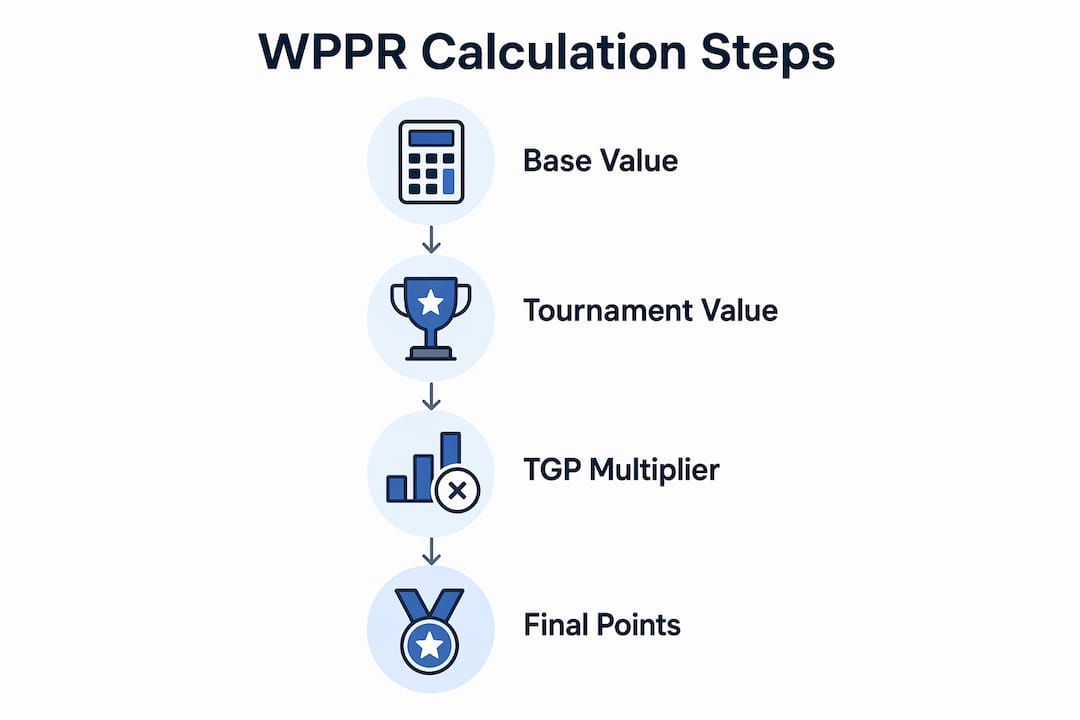
The formula moves through three layers before producing a first-place point value.
Layer 1: Base Value. Every tournament starts with 0.5 WPPR points per Rated player. A player earns “Rated” status after completing five IFPA-sanctioned events. A field of Rated players yields a base value calculated as 0.5 points per Rated player, up to a maximum of 32 WPPR points for events with 64 or more Rated players.
Layer 2: Tournament Value Adjustment (TVA). Two strength indicators are added on top of the base. The Rating-based TVA reflects the average IFPA Rating of the top 64 Rated participants. The Ranking-based TVA uses a logarithmic formula applied to each of the top Ranked players in the field, contributing additional points based on the presence of the world’s top-ranked players.
Layer 3: TGP Multiplier. Once Base + TVA is set, the total is multiplied by the TGP. Under WPPR v6.2 (effective January 1, 2026), events with separate qualifying and finals formats can now grade out to a substantially higher maximum TGP than before, effectively increasing potential point awards. Each meaningful game adds a fixed percentage to the TGP, so a richer format structure directly inflates the final point award.
| Component | Formula / Rule | Maximum Value |
|---|---|---|
| Base Value | 0.5 × Rated players | 32 WPPR points |
| Rating-based TVA | Top 64 Rated players’ ratings | Varies by field quality |
| Ranking-based TVA | Logarithmic formula, top 64 Ranked | 50 WPPR points |
| TGP Multiplier | Meaningful games × a fixed percentage | 200% (with qualifying + finals) |
Pro Tip: If you are hosting an IFPA event, adding a structured finals format that includes an elimination round down to a maximum of four players qualifies your event for the higher TGP ceiling — a straightforward format upgrade that can nearly double the point value on offer.
What do WPPR PRO and Efficiency Percentage actually measure?
WPPR PRO was introduced to correct a real problem: players who attend dozens of low-grade events can accumulate raw WPPR totals that outpace genuinely skilled players who compete less frequently. The adjustment mechanism works through three linked metrics.
- Efficiency Percentage (EFF%): Points earned divided by points available for first place across all active events on a player’s resume. A player who finishes 6th in an event where first place is worth 50 points earns 10 points, giving them a 20% EFF% for that event. The aggregate across all active events becomes their overall EFF%.
- WPPRtunity: An estimate of the total WPPR opportunity a player consumed to generate their top events. It separates players who built their total by chasing volume from those who earned it through quality finishes.
- Strength of Schedule (SOS): Calculated as total active matches against top-250 players divided by total active matches against all players. When SOS exceeds 25%, an adjusted EFF% formula applies, rewarding players who consistently face elite competition. For women’s WPPR PRO, the threshold is set at 40%.
The adjustment sequence: the system identifies the proportion of a player’s WPPRtunity that exceeds a threshold, applies an EFF%-based reduction to that excess, and produces the WPPR PRO total. Two players with identical raw WPPR totals can move in opposite directions after PRO adjustments — the one with higher EFF% and stronger SOS climbs, while the volume-chaser drops.
The WPPRtunity metric is a pragmatic approach to compare two players’ total WPPR points relative to how many points they had to chase — helping separate quantity-driven totals from skill-driven totals.
Which events count, and how long do results last?
Only IFPA-endorsed open divisions count toward WPPR. Team events and special divisions are excluded. New players receive an entry ranking equivalent to the 10th percentile ranked person until they build a Rated history across five events.
Each player’s ranking card draws from their top active events. The rolling three-year window governs what stays “active”: results decay by 25% after each of the first two years, and any result fully past three years drops off entirely. A dominant performance from four years ago contributes nothing to your current ranking.
The Virtual World Pinball Player Rankings (VWPPR) use the same base framework but count a different number of top events for virtual leaderboards, historically tracking up to 40 active events in some periods, compared to the standard live-event card.
| Rule | Live WPPR | VWPPR |
|---|---|---|
| Eligible events | IFPA-endorsed open divisions | IFPA-endorsed virtual events |
| Rolling window | 3 years with decay | 3 years with decay |
| Decay rate | 25% per year (years 1–2) | Same |
| New player seed | 10th percentile ranking | 10th percentile ranking |
Rankings update whenever an organizer submits results to IFPA. There is no fixed weekly cadence; a tournament played on a Saturday can appear on the leaderboard within days if the director files promptly. For endorsement eligibility, events must be listed on the IFPA calendar in advance.
How do format choices and field strength shape an event’s grade?
The two TVA strength indicators work independently. The Rating-based TVA rewards fields packed with highly rated players regardless of their global rank. The Ranking-based TVA rewards the presence of the world’s top-ranked competitors specifically. An event can score well on one indicator and modestly on the other, so organizers benefit from attracting both high-rated regulars and top-ranked stars.
What makes an event genuinely high-value under the current WPPR formula:
- A large field of Rated players (64+ to hit the 32-point base cap).
- Attendance by top-ranked players, since the logarithmic TVA formula rewards each additional top-ranked entrant.
- A finals format that includes an elimination bracket down to four players, qualifying the event for TGP above 100%.
- Under v6.2, organizers can count either +1 meaningful game per full finals round or +1/3 meaningful game per concurrently played game — the choice affects TGP directly.
Pro Tip: Switching from a pure round-robin finals to a single-elimination bracket that ends at a four-player semifinal is often the single highest-leverage format change an organizer can make. It unlocks the 200% TGP ceiling and signals to top players that the event is worth the travel.
Why do rankings matter to collectors, arcade operators, and buyers?
The pinball ranking system carries real commercial weight, and savvy buyers and operators have started treating WPPR data as a market signal rather than a hobbyist curiosity.
For operators, hosting high-TGP IFPA events draws competitive players who travel specifically for ranked tournaments. That foot traffic translates directly into revenue, and a venue that consistently hosts strong-field events earns a reputation as a regional hub. Understanding how pinball machines elevate bar revenue becomes even more compelling when those machines are the centerpiece of a ranked competitive circuit.
For collectors, tournament pedigree shapes desirability. Titles that appear frequently at high-WPPR events develop a competitive cachet that supports stronger resale prices. A machine associated with a prestigious event series carries a story, and stories sell. Collectors who track pinball machine value already know that provenance and cultural relevance move prices as much as condition does.
Hosting even a single high-TGP IFPA event can transform a venue’s identity in the local pinball community — and that community loyalty pays dividends in repeat visits, word-of-mouth, and machine utilization rates that casual operators rarely achieve.
Common misconceptions about the pinball ranking system
The IFPA explicitly designs WPPR to be objective and worldwide, adjusting the formula whenever community feedback reveals a loophole. Still, several myths persist.
- “Attend more events and climb the list.” The top-events rule and EFF% make this strategy self-defeating. Adding low-grade events to your resume can actually lower your EFF%, which hurts your WPPR PRO standing even if raw points tick upward.
- “Rankings favor players in pinball-dense regions.” The formula is location-neutral, but opportunity density creates real access gaps. IFPA addresses this through country qualifying allocations for championship events, giving players in lower-density regions a pathway regardless of raw WPPR totals.
- “One massive win locks in a top ranking.” Decay reduces that result’s value by 25% after year one and another 25% after year two. Three years out, it vanishes entirely. WPPR PRO adjustments further dilute a single outlier result relative to a player’s overall EFF%.
- “Raw WPPR rank tells the whole story.” Look at EFF%, WPPRtunity, and SOS together. A player ranked 50th with a high EFF% and strong SOS is often a more formidable competitor than a player ranked 30th on volume alone.
A worked example: from raw inputs to WPPR points
Here is a simplified calculation to make the mechanics concrete.
Scenario: A regional tournament draws 40 Rated players. The top 64 Ranked players are not all present, but the field includes several top-250 competitors whose logarithmic TVA contribution totals 12 points. The Rating-based TVA adds another 8 points. The event uses a structured qualifying round plus a single-elimination finals bracket, earning a TGP of 120%.
| Step | Calculation | Result |
|---|---|---|
| Base Value | 40 Rated players × 0.5 | 20 WPPR points |
| Ranking-based TVA | Field contribution (hypothetical) | +12 WPPR points |
| Rating-based TVA | Field rating quality (hypothetical) | +8 WPPR points |
| Base + TVA | 20 + 12 + 8 | 40 WPPR points |
| TGP Multiplier | 40 × a multiplier | 48 WPPR points (1st place) |
Now consider the WPPR PRO adjustment for the winner. If that player’s overall EFF% across active events is 35% and their WPPRtunity analysis shows they consumed more opportunity than their top-event quality justifies, the PRO formula reduces a portion of their excess points. A competitor with a 55% EFF% and a high SOS would see their WPPR PRO total hold closer to their raw figure — or even improve relative to the volume player.
For a buyer or operator, the 48-point first-place value signals a mid-prestige regional event: meaningful enough to attract serious players, accessible enough to host at a well-equipped venue. A tournament-ready machine in excellent condition is the foundation that makes hosting that event possible.
Key Takeaways
The WPPR pinball ranking system rewards consistent, high-quality performance across strong fields — not raw event volume — making EFF% and TGP the two metrics that matter most to players and operators alike.
| Point | Details |
|---|---|
| Three inputs drive every award | Base value, TVA (Rating + Ranking), and TGP multiply together to set first-place WPPR points. |
| WPPR PRO rewards quality over volume | EFF% and WPPRtunity adjustments mean attending more low-grade events can hurt your standing. |
| Results decay over three years | Points lose 25% of value after year one, another 25% after year two, then drop off entirely. |
| Format choices control TGP | Adding a proper elimination finals bracket can push TGP to 200%, nearly doubling point value. |
| Rankings signal machine and venue prestige | High-WPPR events raise a venue’s profile and can support stronger resale values for associated titles. |
The Premiumpinballs perspective on rankings and the market
Rankings have quietly become one of the most useful signals in the pinball market, and at Premiumpinballs, we pay close attention to them when advising buyers and curating inventory.
When a title like Attack From Mars or The Addams Family appears repeatedly at high-WPPR events, demand for that machine in collector and operator circles tends to follow. We factor that competitive visibility into how we describe machines, how we price refurbished inventory, and which titles we prioritize sourcing. A machine with tournament pedigree is not just a game — it is a prestige asset with a story that resonates with serious buyers.
For operators considering hosting ranked events, the path is more accessible than most realize. The right machine, properly maintained and placed in a venue with a structured format, can qualify for IFPA endorsement and start generating the kind of foot traffic that transforms a bar or entertainment venue into a destination. Our team is available to consult on machine selection, delivery logistics, and the features that matter most for competitive play.

Whether you are building a home collection around titles that matter to the competitive community or outfitting a venue to host your first IFPA event, Premiumpinballs has the inventory, expertise, and support to make it happen. Explore our best machines for arcades or browse our 2025 top picks to find the right machine for your goals.
Useful sources and next reads
For players, organizers, and buyers who want to verify the formulas or dig deeper into IFPA methodology, these primary sources are the authoritative starting point.
- IFPA Rankings Information 2026 — full breakdown of base value, TVA, TGP, and point distribution formulas.
- WPPR v6.0 Calculation Process — detailed explanation of WPPR PRO, EFF%, WPPRtunity, and SOS.
- WPPR v6.2 Formula Change for 2026 — the specific finals-format and meaningful-games changes effective January 1, 2026.
- IFPA FAQ — covers decay rules, endorsement requirements, and country qualifying allocations.
- IFPA VWPPR Rankings Information — virtual rankings framework and top-event count differences.
- Premiumpinballs: Understanding Pinball Machine Value — how tournament pedigree and player demand factor into machine valuation.
- Premiumpinballs: Pinball Machine Value Guide 2026 — deeper valuation metrics for collectors and operators evaluating event-driven demand.