

TL;DR:
- Warranties are legal promises from sellers to repair, replace, or refund for defective products under federal and state laws. Knowing the type of warranty and properly documenting claims helps consumers enforce their rights effectively. Clear, transparent warranty terms increase an asset’s value and buyer confidence in high-value purchases like refurbished pinball machines.
A warranty is a seller’s legal promise to repair, replace, or refund when a purchase fails to meet stated standards or representations. The moment you complete a transaction, that promise becomes enforceable under a framework anchored by the Federal Trade Commission, the Magnuson-Moss Warranty Act, the Uniform Commercial Code, and state consumer protection laws. Together, these create the legal backbone behind the role of warranty in purchases — and they give you real leverage when something goes wrong.
Your first move after any significant purchase: save the receipt, download or photograph the warranty document, and register the product if the seller requires it. Those three steps cost nothing and can mean the difference between a smooth claim and a frustrating dead end.
Table of Contents
- What are the main types of warranties you can receive?
- How do warranties differ from indemnities in a sale contract?
- What federal rules govern warranties in the United States?
- How do state law and the UCC create implied warranty rights?
- What do warranties typically cover, and what do they exclude?
- How do you actually make a warranty claim, step by step?
- What should you check about warranty terms before you buy?
- Why warranties matter especially for high-value refurbished purchases
- When a warranty won’t fully protect you
- Key Takeaways
- Why clear warranty terms build the buyer confidence that matters
- Premiumpinballs backs every purchase with transparent warranty and return terms
- Authoritative resources for further action
What are the main types of warranties you can receive?
Every warranty you encounter falls into one of three legal categories, and knowing which one you have tells you exactly what you can demand.
Express warranty: Created by any affirmation of fact, promise, description, or sample that becomes part of the basis of the bargain between seller and buyer. The seller does not need to use the word “warranty” or “guarantee.” A product listing that states “all components are defect-free for 12 months” is an express warranty. Under UCC § 2-313, even a sample shown during a sale creates an express warranty that the full goods will match it.
Implied warranty of merchantability: Automatically applies under state law and UCC § 2-314 whenever a merchant sells goods of the kind they regularly deal in. It promises the goods are reasonably fit for their ordinary, intended purpose and free of defects. No written document is required — the law creates it by default.
Implied warranty of fitness for a particular purpose: Arises when a seller knows the buyer needs goods for a specific use and the buyer relies on the seller’s judgment to select them. If a seller recommends a particular machine for commercial venue use and it cannot handle that load, this warranty may be breached.
Warranty of title: Under UCC § 2-312, every sale of goods carries an automatic promise that the seller has the legal right to transfer ownership and that the goods are free from undisclosed liens or encumbrances. This protects you from unknowingly purchasing stolen or legally encumbered property.
A short example clarifies each in practice. Suppose you purchase a refurbished arcade machine. The seller’s written description stating “fully restored electronics, 90-day parts warranty” is an express warranty. The background promise that the machine will actually function as an arcade machine is the implied warranty of merchantability. If the seller specifically recommended that model for a high-traffic bar environment, the fitness warranty applies. And the promise that the seller actually owns the machine free and clear is the warranty of title.
How do warranties differ from indemnities in a sale contract?
Buyers sometimes see both “warranty” and “indemnity” clauses in a purchase agreement and assume they cover the same ground. They do not.
A warranty is a contractual promise about the condition or performance of the goods themselves. When a warranty is breached, the buyer’s remedy runs directly against the seller: repair, replacement, or refund. The trigger is a defect or failure in the product.
An indemnity is a promise by one party to cover losses, costs, or liabilities that arise from third-party claims or specified events. The trigger is not a product defect but a claim brought by someone outside the transaction — for example, a customer injured by the product, or a lawsuit alleging the goods infringed a patent.
The practical distinction: A warranty claim asks, “Did the product work as promised?” An indemnity claim asks, “Who pays when a third party sues because of this product?” Warranties protect the buyer from the seller’s failure to deliver. Indemnities protect the buyer from being dragged into someone else’s dispute about the goods.
Consider a concrete contrast. You buy a pinball machine and the playfield lighting fails within the warranty period. That is a warranty claim: you contact the seller, document the defect, and request repair or replacement. Now suppose a visitor to your venue is injured and claims the machine was defective. If the purchase contract contains an indemnity clause, the seller may be obligated to defend and pay for that third-party claim. Two very different protections, triggered by very different events.
In consumer purchases, indemnities are rare. They appear most often in commercial sale contracts where the stakes and third-party exposure are higher. As an individual buyer, your primary protection is the warranty.
What federal rules govern warranties in the United States?
Three federal instruments shape what sellers must do and what buyers can expect from any written warranty on a consumer product.

| Federal Rule | What It Requires | Buyer Benefit |
|---|---|---|
| Magnuson-Moss Warranty Act | Written warranties on consumer products over $15 must be labeled “full” or “limited” and disclosed in clear, simple language | Buyers know upfront whether they get full repair/replace/refund rights or a narrower remedy |
| FTC Pre-Sale Availability Rule | Full warranty text must be available to buyers before purchase, in-store and online | You can read the exact terms before you commit — not after |
| 15 U.S.C. § 2304 Federal Minimum Standards | Warrantors must remedy defects within a reasonable time and without charge; after a reasonable number of failed repair attempts, buyer may elect refund or replacement | Sellers cannot stall indefinitely or charge you for covered repairs |
| Written Warranty Disclosure Requirements | Written warranties must identify the warrantor, state what the warrantor will do, specify when coverage begins, and include a statement that state rights may vary | Buyers receive a complete, standardized disclosure rather than vague marketing language |
The “full” versus “limited” distinction under Magnuson-Moss carries real weight. A full warranty must remedy defects within a reasonable time and at no charge, cannot require the buyer to perform unreasonable duties as a condition of getting service, and must offer refund or replacement after a reasonable number of failed repair attempts. A limited warranty may narrow those remedies — restricting coverage to parts only, requiring the buyer to pay labor, or limiting the duration of implied warranties.
The phrase “without charge” in § 2304 means the warrantor cannot bill you for any costs it or its representatives incur in performing the required remedy. If the warrantor fails to fix the product within a reasonable time, you become entitled to recover reasonable incidental expenses you incurred because of that delay.
Pro Tip: Before purchasing any consumer product with a written warranty, use the FTC Pre-Sale Availability Rule to your advantage: ask the seller to provide the full warranty text before you pay. If they cannot or will not, that is a red flag worth taking seriously.
How do state law and the UCC create implied warranty rights?
Federal law sets a floor; state law and the Uniform Commercial Code fill in the rest. Every state has adopted some version of the UCC, and Article 2 creates implied warranties that attach automatically to most sales of goods — no written document required.
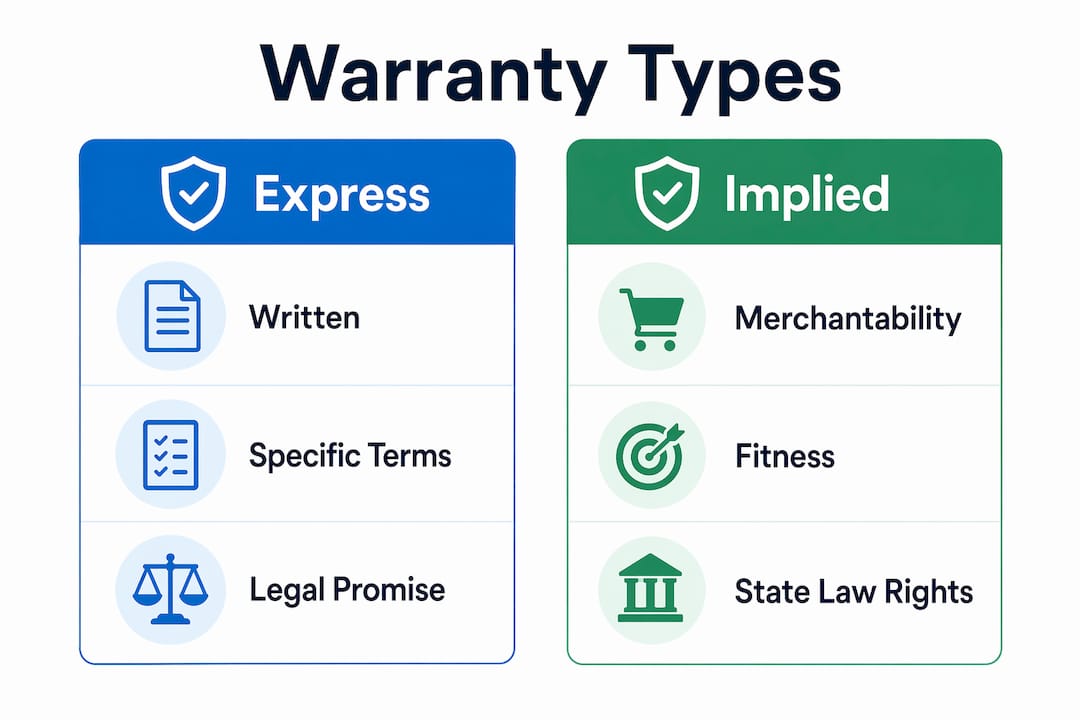
The implied warranty of merchantability applies whenever a merchant sells goods of the kind they regularly deal in. It does not promise perfection; it promises that the goods are reasonably fit for their ordinary purpose. A pinball machine that powers on but whose playfield is non-functional likely breaches this warranty. A machine with minor cosmetic wear that plays correctly does not.
How sellers can disclaim implied warranties
Sellers may attempt to eliminate implied warranties, but the rules are strict:
- An “as is” or “with all faults” clause, if conspicuous, can disclaim all implied warranties under UCC § 2-316.
- A written disclaimer of the implied warranty of merchantability must use the word “merchantability” explicitly and must be conspicuous — meaning a reasonable buyer would notice it (large font, contrasting color, or a separate bold heading).
- A disclaimer buried in fine print or written in the same size and style as surrounding text is likely ineffective.
One scenario where implied warranty protection disappears regardless of disclaimers: if you inspect the goods before purchase, or if you refuse the seller’s offer to inspect, you lose implied warranty protection for any defect that the inspection would have revealed. A buyer who examines a machine in person and misses a visible crack in the cabinet cannot later claim that defect under the implied warranty of merchantability.
Timing and statutes of limitation
Under UCC Article 2, the default statute of limitations for a breach of warranty claim is four years from when the breach occurred (generally, delivery of the goods). Some states have modified this period. State lemon laws, which vary significantly, may provide additional protections for certain consumer goods beyond what the UCC offers. Checking your state attorney general’s consumer protection office is the fastest way to confirm your state’s specific rules.
What do warranties typically cover, and what do they exclude?
Understanding the gap between what a warranty promises and what it actually delivers is where most buyers get caught off guard.
| Coverage Category | Typically Included | Typically Excluded |
|---|---|---|
| Defects in materials/workmanship | Yes — manufacturing defects within the warranty period | Damage from misuse, unauthorized modifications, or accidents |
| Parts | Usually covered under full warranties; may be parts-only under limited warranties | Consumable parts (bulbs, rubber rings, fuses) often excluded |
| Labor | Covered under full warranties; often excluded or charged under limited warranties | Labor for user-caused damage |
| Consequential damages | Excluded in most limited warranties | Lost profits, business interruption, secondary damage |
| Shipping/transport costs | Varies; some require buyer to pay return shipping | Return shipping often buyer’s responsibility unless warranty specifies otherwise |
| Commercial use | Often excluded when only a consumer warranty exists | High-traffic commercial use on a consumer-grade product |
Exclusions worth reading carefully
Wear and tear is the most common exclusion. Rubber parts, display bulbs, and mechanical components that degrade through normal use are almost never covered. User modification voids coverage in virtually every written warranty — if you open the cabinet and alter the electronics, the express warranty is gone.
Consequential damage exclusions deserve particular attention. Most limited warranties state that the seller is not liable for any indirect, incidental, or consequential damages. In practice, this means that if a machine failure causes secondary damage — say, a power surge damages connected equipment — the warranty will not cover that secondary loss. Under a full Magnuson-Moss warranty, however, consequential damage exclusions face limits.
Arbitration clauses are increasingly common in written warranties. They require you to resolve disputes through private arbitration rather than court. Read this language before purchase; some states limit the enforceability of mandatory arbitration clauses in consumer contracts.
How do you actually make a warranty claim, step by step?
Knowing your rights matters less than knowing how to use them. Here is a practical roadmap for any covered defect.
Document the problem immediately. Photograph or video the defect, note the date it appeared, and write down the circumstances. Specificity strengthens every subsequent step.
Locate your proof of purchase and warranty document. You need the original receipt (or order confirmation), the serial number, and the full warranty text. If you registered the product, pull that confirmation as well.
Contact the seller first. Many warranty claims resolve at this stage. Describe the defect clearly, reference the warranty terms, and request the specific remedy you are entitled to (repair, replacement, or refund).
Escalate to the manufacturer if the seller does not resolve it. Use the contact information in the warranty document. Send your notice in writing — email with read receipt, or certified mail with return receipt requested — to create an evidentiary record.
Track repair attempts and timelines. Under federal minimum standards, after a reasonable number of failed repair attempts, you are entitled to elect a refund or replacement. Keep a written log of every repair attempt: date, what was done, and the outcome.
Send a formal written demand if repairs stall. A certified letter stating the defect, the repair history, and your demand for replacement or refund creates the paper trail you need for any escalation.
Escalate if the warrantor does not respond. Your options include filing a complaint with the FTC, contacting your state attorney general’s consumer protection division, initiating the warranty’s own dispute resolution procedure if one exists, or filing in small claims court for amounts within your state’s threshold. For larger amounts or complex commercial disputes, consulting a consumer protection attorney is worth the cost.
Pro Tip: Certified mail with return receipt is not just formality — it is evidence. A warrantor who later claims they never received your notice cannot make that argument when you have a signed return receipt in hand.
What should you check about warranty terms before you buy?
The best time to evaluate a warranty is before the transaction closes, not after a defect appears. These are the questions worth asking and the terms worth confirming at the point of sale.
- Duration: How long does coverage last, and when does it start? A warranty that begins on the ship date rather than the purchase date can quietly shave days or weeks off your coverage window.
- Who is the warrantor? Is it the retailer, the manufacturer, or a third party? Knowing who you call matters when something goes wrong.
- What exactly is covered? Parts only? Parts and labor? All defects or only manufacturing defects? Ask for the written document and read the coverage section before signing anything.
- Registration requirements: Some warranties require product registration within a set number of days to activate coverage. Miss that window and you may lose the warranty entirely.
- Proof of purchase requirements: Confirm what documentation the warrantor will accept. A digital order confirmation usually suffices, but some warrantors require the original paper receipt.
- Shipping and labor costs: Who pays to ship the product for repair? Who pays for the technician’s time? Under a limited warranty, these costs often fall to you.
- Implied warranty status: Ask whether the seller is disclaiming implied warranties. If the contract contains “as is” language, you are likely giving up UCC protections.
- Verbal promises: If a salesperson makes a specific promise about performance or coverage that is not in the written warranty, ask for it in writing before purchase. Verbal warranties are legally enforceable as express warranties, but proving them without documentation is difficult.
Pro Tip: Watch for the phrase “warranty commences on date of manufacture” or “ship date.” On a refurbished or older-stock item, that language can mean your warranty period is already partially or fully elapsed before the machine arrives at your door. Always confirm the start date in writing.
Why warranties matter especially for high-value refurbished purchases
The role of warranty in purchases becomes most consequential when the price tag is high and the product’s history is unknown. Refurbished goods — pinball machines included — sit at exactly that intersection.

A refurbished pinball machine can represent a genuinely prestigious acquisition: classic titles like The Addams Family or Attack From Mars carry real collector appeal and can command prices that rival new consumer electronics. At that price point, a defect in the playfield electronics, the display, or the mechanical assemblies is not a minor inconvenience. Repair costs for specialized components can be substantial, and parts for vintage machines are not always readily available.
This is why buyers of high-value refurbished machines should confirm several things before finalizing payment:
- Refurbishment scope: What was actually restored or replaced? Ask for a written description of the work performed, not just a general “fully refurbished” claim.
- Serial number verification: Confirm the serial number matches the documentation and that the machine has no outstanding liens — the warranty of title matters here.
- Service history: Has the machine been in commercial use? Commercial wear differs significantly from residential use and may affect both condition and warranty eligibility.
- Return window: What is the return policy if the machine arrives with undisclosed defects? A clear, written return window is a meaningful protection.
- Warranty start date: As noted above, confirm coverage begins on your purchase date, not an earlier date.
Premiumpinballs structures its product listings to address these concerns directly, providing detailed condition disclosures, warranty terms, and return policy information on each product page. For buyers who want to understand how to manage pinball warranties and protect their investment over time, that transparency is the foundation of a confident purchase.
Pro Tip: For any refurbished machine above a certain value threshold, consider a pre-purchase inspection by an independent technician before finalizing payment. A qualified technician can identify hidden defects that photographs and descriptions may not capture — and that inspection report becomes useful documentation if a warranty claim arises later.
When a warranty won’t fully protect you
A warranty is a powerful tool, but it has real limits. Knowing those limits in advance lets you layer in additional protections where the warranty falls short.
Scenarios where warranty coverage is likely inadequate:
- “As is” sales: A conspicuous “as is” clause eliminates implied warranties entirely. If you buy a machine sold explicitly as-is, your only protection is whatever express warranty the seller has written — which may be none.
- End-of-life parts: When a manufacturer discontinues a product line, replacement parts may become unavailable. A warranty that promises repair is worth less when the warrantor cannot source the components.
- Third-party modifications: Any modification by someone other than the warrantor typically voids coverage. If a previous owner modified the machine’s electronics, the manufacturer’s warranty likely does not apply.
- Commercial use on a consumer warranty: Many written warranties explicitly exclude commercial use. If you operate a machine in a venue under a consumer warranty, a claim may be denied.
Complementary protections worth considering:
Extended service contracts are sold separately from the product and cover repairs beyond the original warranty period. The FTC notes that written warranties differ from service contracts — service contracts are paid agreements with their own terms and are not part of the original sale. Read them carefully before purchasing.
For commercial buyers, indemnity clauses in the purchase contract can shift liability for third-party claims. Escrow or holdback arrangements in business-to-business sales provide a financial cushion if defects emerge after closing. For high-value consumer purchases, some homeowner or renter insurance policies cover certain personal property losses that a product warranty would not.
Understanding pinball machine ownership costs — including potential repair expenses — helps you decide whether an extended service contract makes financial sense for your specific acquisition.
Key Takeaways
A warranty’s role in purchases is to give buyers a legally enforceable right to repair, replacement, or refund — but only if you know the terms, document your claim, and act within the right timeframe.
| Point | Details |
|---|---|
| Know your warranty type | Express, implied (merchantability and fitness), and title warranties each give different rights and have different triggers. |
| Federal law sets a floor | Magnuson-Moss and 15 U.S.C. § 2304 require warrantors to remedy defects without charge and allow refund or replacement after failed repair attempts. |
| Disclaimers must be conspicuous | An “as is” clause or merchantability disclaimer is only effective if it is clearly visible and uses the required legal language under UCC § 2-316. |
| Document everything | Certified mail, repair logs, and saved receipts create the evidentiary record that supports escalation to the FTC, state AG, or small claims court. |
| Premiumpinballs provides transparency | Detailed product listings, written warranty terms, and clear return policies give buyers the pre-purchase information federal law requires and buyers deserve. |
Why clear warranty terms build the buyer confidence that matters
Most buyers focus on price and features. The warranty gets a quick glance, if that. That is a mistake I think the industry has quietly encouraged — because a vague warranty protects the seller far more than the buyer.
Here is what the conventional wisdom misses: the value of a warranty is not just in what it covers. It is in how clearly it is written. A warranty that says “defects in materials and workmanship for 12 months from purchase date, parts and labor included, with replacement after two failed repair attempts” gives you a roadmap. A warranty that says “covered at our discretion for a reasonable period” gives you nothing but a phone call you will probably lose.
The Magnuson-Moss framework was designed precisely to close that gap — to force sellers to commit to specific language rather than hide behind vague promises. But the law only works if buyers read the document before they buy. The FTC Pre-Sale Availability Rule exists because Congress recognized that most buyers never saw the warranty until after the sale. That is still true today.
For high-value purchases like premium pinball machines, the warranty is part of the asset’s value proposition. A machine with a clear, written, transferable warranty is worth more than an identical machine sold as-is. That is not sentiment — it is the practical reality of resale value and collector appeal. Buyers who understand this use warranty terms as a negotiating point, not an afterthought.
The sellers worth doing business with are the ones who make their warranty terms easy to find, easy to read, and easy to enforce. That transparency is the clearest signal of a seller who stands behind what they sell.
Premiumpinballs backs every purchase with transparent warranty and return terms
When you are investing in a premium pinball machine — whether a collector-grade classic or a refurbished title for your home game room — the warranty and return policy are as much a part of the purchase as the machine itself. Premiumpinballs is built around that principle.

Every listing on Premiumpinballs includes detailed condition disclosures, written warranty terms, and return policy information so you can read the full terms before you commit — exactly as the FTC Pre-Sale Availability Rule requires and as any discerning buyer should expect. Whether you are browsing the best pinball machines for arcades or considering a refurbished unit for your home, the warranty details are there on the product page, not buried in fine print you find after checkout.
- Written warranty terms available before purchase on every product listing
- Clear return window and condition disclosure for refurbished and used machines
- Customer support available to answer warranty questions before and after purchase
- Shipping and delivery terms specified so you know who is responsible at every stage
- Guidance on product registration and documentation to activate and protect your coverage
Ready to find your next machine with full confidence in the terms? Browse our current inventory or contact our team directly with any warranty questions before you buy.
Authoritative resources for further action
| Resource | What It Offers | Best Used For |
|---|---|---|
| Consumer Product Warranties | Full statutory text of the Magnuson-Moss Warranty Act, including definitions and federal minimum standards | Reading the exact law that governs your written warranty rights |
| FTC Consumer Advice: Warranties | Plain-language buyer guidance, documentation tips, and complaint filing links | Understanding your rights and filing an FTC complaint |
| FTC Businessperson’s Guide to Federal Warranty Law | Detailed explanation of Magnuson-Moss obligations for warrantors | Verifying whether a seller’s warranty meets federal requirements |
| UCC § 2-313 — Express Warranties | Statutory text on how express warranties are created | Confirming whether a seller’s statement or description created a warranty |
| UCC § 2-314 — Implied Warranty of Merchantability | Statutory text on the automatic merchantability warranty | Understanding your baseline implied warranty rights |
| UCC § 2-312 — Warranty of Title | Statutory text on title and encumbrance warranties | Protecting yourself from purchasing goods with undisclosed liens |
| Written Warranty Disclosure Requirements | Required elements every written warranty must include | Checking whether a written warranty meets federal disclosure standards |
| State Attorney General Consumer Protection Office | State-specific lemon laws, implied warranty rules, and complaint filing | Filing a state-level complaint or checking your state’s warranty statutes |
This article provides general legal information about U.S. warranty law for educational purposes. It is not legal advice. For questions about your specific situation, consult a qualified consumer protection attorney or contact the relevant primary source or government agency directly.
Recommended
- How to manage pinball warranties to protect your investment
- Return Policies in Pinball Shopping: Your Buyer’s Guide
- How to handle your pinball purchase checklist – Pinball Machines for Sale – Premium Pinballs LLC
- Pinball Machine Appreciation: Complete Guide – Pinball Machines for Sale – Premium Pinballs LLC