

TL;DR:
- Multiball elevates pinball gameplay by activating multiple balls to increase scoring opportunities and excitement. Its design complexity and hardware condition significantly influence maintenance costs and collection value. A well-executed multiball mode creates lasting appeal and high replayability, making it essential for serious collectors.
Multiball is a game mode where more than one ball is in play simultaneously, multiplying scoring opportunities through jackpots, playfield multipliers, and lit shot sequences. Most machines use 2- or 3-ball multiball, triggered by locking balls in designated areas before the game releases them all at once. For collectors and buyers, understanding multiball is not just about gameplay — it shapes maintenance complexity, restoration cost, and long-term resale appeal. Pinball analyst Ryan Thompson frames multiball as the “primary objective for top-score play” because it multiplies scoring potential more than any other single feature. Machines like the Addams Family, Attack From Mars, and Ghostbusters built their collector prestige largely on the quality of their multiball implementations, and Premiumpinballs stocks and documents these titles precisely because multiball is what separates a memorable machine from a forgettable one.
- Multiball puts 2 or more balls in play at once, dramatically increasing scoring pace.
- Most modes require locking three balls before release.
- Classic titles like Addams Family and Attack From Mars are collector favorites partly because of their well-designed multiball modes.
- Premiumpinballs lists multiball details on every product page so buyers can evaluate features before purchasing.
Table of Contents
- How is multiball activated on a pinball machine?
- What types of multiball are there, and how do they differ?
- How do scoring and jackpots work during multiball?
- What strategy helps you survive and score during multiball?
- How should multiball affect your buying and collecting decisions?
- Key Takeaways
- Why multiball is the feature that defines a collection
- Premiumpinballs stocks machines with tested, warranty-backed multiball
- Useful sources
How is multiball activated on a pinball machine?
Activation always starts with ball locks. The player hits specific targets, ramps, or saucers to “lock” a ball in a designated area. Once the required number of locks is reached, the machine releases all locked balls simultaneously and multiball begins.
Two distinct locking systems exist across eras and manufacturers:
- Physical locks use solenoid gates or captive wells that physically hold each ball in place. You can see and hear the ball sitting in the lock. These mechanisms are satisfying but add mechanical complexity and wear points.
- Virtual locks track locks electronically in software. The ball drains normally into the trough, and when multiball starts, the auto-launcher fires multiple balls onto the playfield. Fewer moving parts means lower repair risk, though the tactile feedback differs.
| Lock Type | How It Works | Typical Ball Count | Repair Complexity |
|---|---|---|---|
| Physical gate | Solenoid holds ball in lock area | multiple balls | Moderate (solenoid, switch) |
| Captive well | Ball sits in recessed pocket | multiple balls | Moderate (switch, coil) |
| Virtual / software | Ball drains; trough auto-launches | multiple balls | Low (software-driven) |
The launch sequence itself matters too. Once locks are complete, a ball saver window opens, giving players a few seconds of protected play before drains count. Quick multiball variants need only one or two locks; discipline-based modes on titles like Attack From Mars require repeated precise shots to lock three balls before the mode fires.
Pro Tip: When demoing a machine, watch the auto-launch mechanism closely. A slow or inconsistent auto-kick from the trough during multiball startup often signals a weakening solenoid — one of the most common maintenance items on virtual-lock machines.
What types of multiball are there, and how do they differ?
Multiball reappeared as a widespread feature around 1980 with solid-state electronics, and designers have been refining the concept ever since. Today, most machines after the mid-1990s include multiple distinct multiball modes within a single title.
The main types collectors encounter:
- Quick multiball: Minimal setup, often one or two shots. Designed for fast payoff and casual players.
- Mode-based multiball: Tied to a specific story mode or mission sequence. Requires completing objectives before the mode unlocks.
- Wizard-mode multiball: The endgame reward, typically 4–6 balls, reserved for players who complete most of the machine’s objectives.
- Thematic multiball: Branded around the machine’s license, with themed jackpot names and custom lock sequences (e.g., the Ghostbusters Slime multiball).
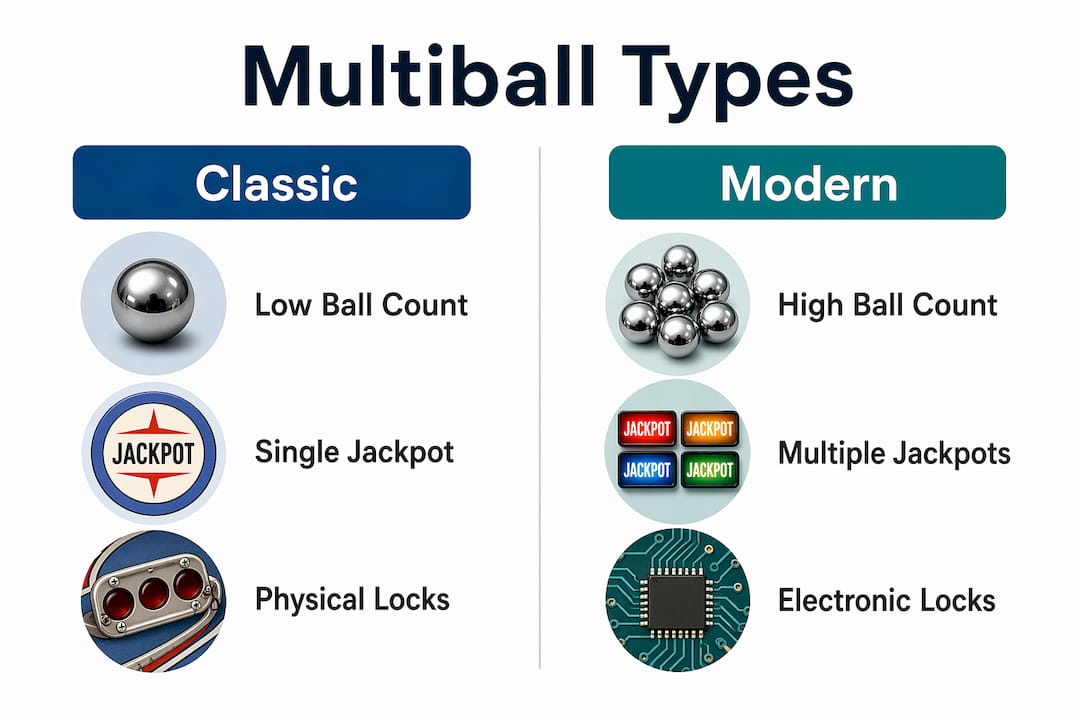
The contrast between classic and modern design is sharp:
| Feature | Classic (Williams/Bally pre-1995) | Modern (Stern and later) |
|---|---|---|
| Ball count | Typically multiple balls | Multiple balls, multiple modes |
| Lock mechanism | Predominantly physical | Mix of physical and virtual |
| Time to trigger | Often longer, disciplined shots | Quick variants common |
| Jackpot behavior | Single large jackpot | Multiple smaller jackpots |
| Era | 1980–mid-1990s | Mid-1990s to present |
Classic Williams and Bally machines rewarded patience with one large, satisfying jackpot. Modern Stern titles spread the scoring across several shots, which keeps players engaged longer but dilutes the single-moment payoff. Neither approach is objectively superior — they suit different play styles, and knowing which you prefer is genuinely useful before you buy.
How do scoring and jackpots work during multiball?
Multiball is the primary scoring opportunity on most machines, and the jackpot structure determines how dramatic that opportunity feels. Classic machines accumulated a single large jackpot between games, making each multiball a high-stakes moment. Modern titles typically distribute several fixed-value jackpots across multiple shots during the mode.
Scoring layers during multiball include:
- Standard jackpots: Awarded for hitting designated shots while multiple balls are in play.
- Super jackpots: Higher-value awards placed on the hardest shots, often upper-flipper ramps or tight orbit entries.
- Playfield multipliers: Some machines activate a 2X or 3X multiplier when a set number of balls is in play simultaneously.
- Mode-specific bonuses: Completing sequences during multiball can stack additional point awards.
Designers sometimes deliberately place the Super Jackpot on the most difficult shot to create a risk/reward tension. On Attack From Mars, for example, the saucer shot during multiball is both the highest-value target and the hardest to hit consistently under pressure.
Pro Tip: During multiball, ignore low-value targets and focus exclusively on the lit jackpot shots. One Super Jackpot is worth more than a dozen bumper hits.
3-ball multiball is the most common configuration across the hobby, appearing on the vast majority of collector-grade titles. Jackpot design directly affects a machine’s replayability and perceived value — a well-structured multiball keeps players coming back, which matters for both home enjoyment and resale appeal.
What strategy helps you survive and score during multiball?
The instinct during multiball is to panic and flip everything. That instinct costs points. The better approach: slow down, control the balls, and hunt jackpot shots deliberately.
Proven techniques from competitive play:
- Detaining (trapping): Catch a ball in the flipper cradle while the other ball(s) are still in play. This lets you aim one shot precisely instead of reacting to chaos.
- Billiard blocking: Use a trapped ball to redirect another ball’s path, clearing a drain lane.
- Deliberate drain: Sacrifice one ball early in multiball while the ball saver is active, reducing to a single ball you can control while the auto-kick restores it.
- Multitrap escape: When two balls sit on the same flipper, rapid rhythmic taps release only the outermost ball while holding the inner one.
Pro Tip: The deliberate-drain tactic is one of the highest-leverage moves in competitive pinball. If you drain intentionally during the ball-saver window, the machine auto-kicks a replacement ball while you focus on the Super Jackpot with a single controlled ball. Most casual players never try it.
When demoing a machine, test whether ball savers activate reliably and whether the auto-kick timing is consistent. Erratic ball saver behavior is a software or switch issue worth flagging before purchase.
How should multiball affect your buying and collecting decisions?
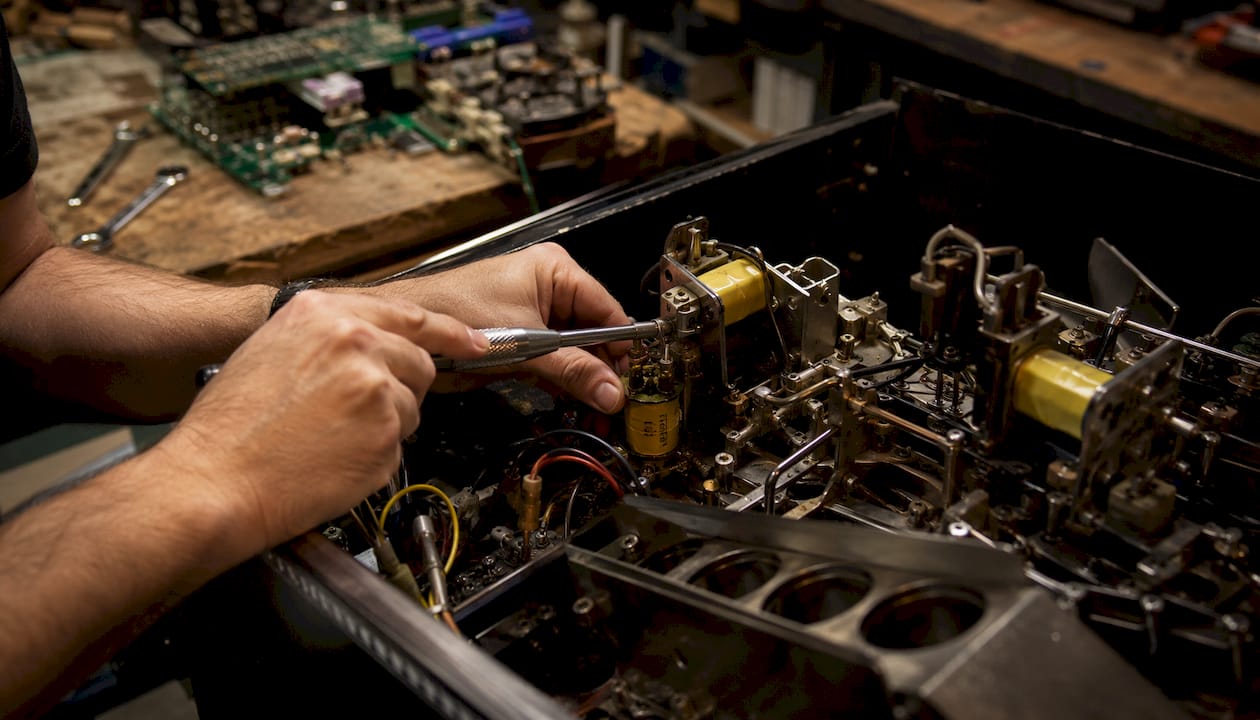
The presence and design of multiball meaningfully affects both enjoyment and maintenance cost. A machine with a complex physical lock system is more engaging but requires more upkeep; a virtual-lock machine is easier to maintain but may feel less tactile. Knowing which trade-off you prefer before you buy saves frustration later.
What to inspect at demo:
- Trigger each lock manually and confirm the solenoid gate holds the ball firmly.
- Run a full multiball sequence and watch the trough auto-launch for consistency.
- Time the ball saver window — it should be predictable and repeatable.
- Hit the jackpot shots during multiball and confirm they register cleanly.
- Check for worn switch assemblies in lock areas, which cause missed lock detections.
| What to test | Why it matters |
|---|---|
| Lock hardware function | Worn gates cause missed locks and broken multiball sequences |
| Trough auto-launch speed | Slow launch signals a weakening solenoid |
| Ball saver timer | Inconsistent timers affect strategy and indicate software issues |
| Jackpot shot registration | Missed shots during multiball break the scoring loop |
| Switch assemblies in lock areas | Faulty switches are the most common multiball repair item |
Three titles stand out for collectors evaluating multiball quality. The Addams Family (Williams, 1992) uses a physical lock with a distinctive magnet-assisted mechanism; its multiball is quick to trigger and deeply satisfying, making it one of the most sought-after collector machines ever produced. Attack From Mars (Williams, 1995) demands disciplined shots to the saucer for each lock, rewarding patient players with a high-value multiball sequence. Ghostbusters (Stern, 2016) layers multiple multiball modes with themed jackpots, representing the modern approach to multiball complexity.
Parts availability matters too. Physical solenoids, captive wells, and switch assemblies for classic Williams and Bally titles are well-documented and widely stocked. Modern Stern machines use virtual locks with fewer mechanical failure points, though proprietary boards can complicate repairs. Collectors who prefer classic Williams/Bally machines often cite parts availability and repairability as key reasons alongside gameplay quality.
Pro Tip: Review the purchase checklist before any demo. Multiball-specific inspection points are easy to overlook when you are caught up in the excitement of play.
Key Takeaways
Multiball is the single most impactful scoring feature in pinball, and its lock mechanism, jackpot structure, and hardware condition should be central to every buying decision.
| Point | Details |
|---|---|
| Core definition | Multiball puts 2 or more balls in play simultaneously, multiplying jackpot and scoring opportunities. |
| Most common configuration | Multiball with a few balls is the standard across collector-grade titles; variants with more balls also exist. |
| Physical vs. virtual locks | Physical gates offer tactile satisfaction but add repair complexity; virtual locks are more reliable but less mechanical. |
| Jackpot structure matters | Classic machines offer one large jackpot; modern titles spread smaller jackpots across multiple shots. |
| Premiumpinballs advantage | Premiumpinballs documents multiball details on every listing and offers inspected, refurbished machines with warranty coverage. |
Why multiball is the feature that defines a collection
Most buyers focus on cabinet art or license themes when shopping for a machine. That is understandable — a majestic Addams Family cabinet is a statement piece in any room. But the feature that determines whether a machine stays in your collection for a decade or gets sold after six months is almost always the quality of its multiball.
A poorly implemented multiball feels random and punishing. A well-designed one creates a rhythm: build toward the lock, survive the chaos, land the jackpot. That loop is what makes pinball genuinely replayable rather than merely decorative. The machines that hold their value — Addams Family, Attack From Mars, Ghostbusters — all share one trait: their multiball modes are memorable enough that players want to trigger them again immediately after draining.
The conventional wisdom says “buy the theme you love.” The more precise advice is: buy the theme you love, then verify the multiball is worth playing 500 times. Those are two different machines, and only one of them belongs in a serious collection.
Premiumpinballs stocks machines with tested, warranty-backed multiball
If you want a machine where multiball performs as intended from day one, Premiumpinballs is the direct path. Every machine in the inventory is inspected for lock hardware function, trough auto-launch consistency, and jackpot shot reliability before it ships. Refurbished titles come with warranty coverage on critical components, including solenoids and switch assemblies — the parts most likely to affect multiball performance.
Collectors and home buyers can browse the best pinball machines of 2025, request a video demo showing multiball in action, or contact the team directly for a full inspection report on any specific title. For buyers weighing refurbished options, the advantages of refurbished machines page explains exactly what the refurbishment process covers and what warranty protections apply. Every listing includes multiball details so you know what you are buying before the machine arrives at your door.
Useful sources
These authoritative resources cover multiball mechanics, strategy, and history in depth.
- Pinball Term Glossary — tcpinball.org: Precise definitions of multiball, add-a-ball, and related terms used by competitive players.
- Pinball — Wikipedia: Historical context on jackpot evolution and the shift from classic to modern multiball design.
- Multiball — Giant Bomb Wiki: Concise overview of multiball history, including the first intentional multiball in Bally’s Balls-A-Poppin (1956) and Williams’ Firepower (1980).
- IPDB — Playing: Multiball: The definitive tactical guide covering detaining, deliberate drains, and multitrap escapes.
- Multiball: How to Activate It…and Survive! — Pinball Land: Practical activation and survival guide with era-specific context.
- Multiball Mode in Pinball: Mechanics and Strategy Guide — Premiumpinballs: Premiumpinballs’ in-depth guide covering mechanics, advanced strategy, and inventory context for buyers.