

Yes — a well-chosen pinball machine measurably increases on-site dwell time and repeat visits when deployed with intention. The role of pinball in retention is grounded in three durable mechanics: a skill curve that rewards repeated play, a social spectacle that draws crowds and creates community, and a physical experience no digital screen can replicate. U.S. venues that integrate quality machines report measurable lifts in customer retention and loyalty, and Premiumpinballs has worked with commercial operators and collectors across the country to put those gains into practice.
Here is why pinball outperforms most alternatives as a retention asset:
- Skill and replayability: Players return to beat their own scores, not just to pass time.
- Social magnetism: A lit, active machine draws onlookers and sparks group competition.
- Long-term durability: A quality machine stays relevant for years without software churn.
Table of Contents
- How pinball keeps people coming back: the psychology behind it
- What the commercial numbers actually look like
- How to deploy pinball in a venue to maximize retention
- How home collectors and buyers create lasting retention value
- How to measure pinball’s impact and calculate realistic ROI
- What to prioritize when buying a machine for maximum retention
- Maintenance and uptime best practices that protect your retention investment
- Key Takeaways
- Why pinball’s retention value is consistently underestimated
- Premiumpinballs has the machines and support to make it work
- Useful sources and resources
How pinball keeps people coming back: the psychology behind it
Pinball’s retention power starts with the gap between where a player is and where they want to be. Unlike slot-style games that rely on chance, pinball rewards accuracy, timing, and pattern recognition. Players return to close that gap, creating a practice loop that skill-based gameplay naturally sustains.
The social layer amplifies this. A machine in active play becomes a performance. Onlookers gather, friendly rivalries form, and the crowd itself becomes part of the draw. This spectator effect is one of the most underappreciated drivers of repeat visits: people come back not just to play, but to be part of the scene.
Leaderboards and leagues extend that loop further. When a player’s initials appear on a high-score screen, the machine becomes personal. Weekly tournaments create appointment visits, turning casual customers into habitual ones. Event programming significantly amplifies repeat play across venue types.
Pro Tip: Place your leaderboard-enabled machine where it faces foot traffic, not a wall. The visible score display is a passive recruitment tool that pulls in new players and reminds regulars they have a score to beat.
What the commercial numbers actually look like
Game rooms with pinball keep customers on-site longer, and that extended dwell time translates directly into secondary spend on food and beverages. The logic is straightforward: every additional minute a guest stays is another opportunity for a drink order, a snack, or a second round of games.
Operators also report that well-placed machines attract longer-stay, hobbyist, and group customers rather than quick impulse players, which raises average revenue per visit. Leagues and tournaments convert that pattern into something more valuable: habitual customers with a standing reason to return every week.
A well-maintained pinball machine can generate significant weekly revenue depending on foot traffic, and its skill-based appeal means players are motivated to return repeatedly — chasing improvement, not just entertainment.
The resale dimension matters for CAPEX decisions too. Operators value earnings history when buying location games, and a machine with documented play logs gives you a defensible ROI case before you commit. That combination of operating income and residual value makes pinball one of the more capital-efficient entertainment assets on a venue floor.
How to deploy pinball in a venue to maximize retention
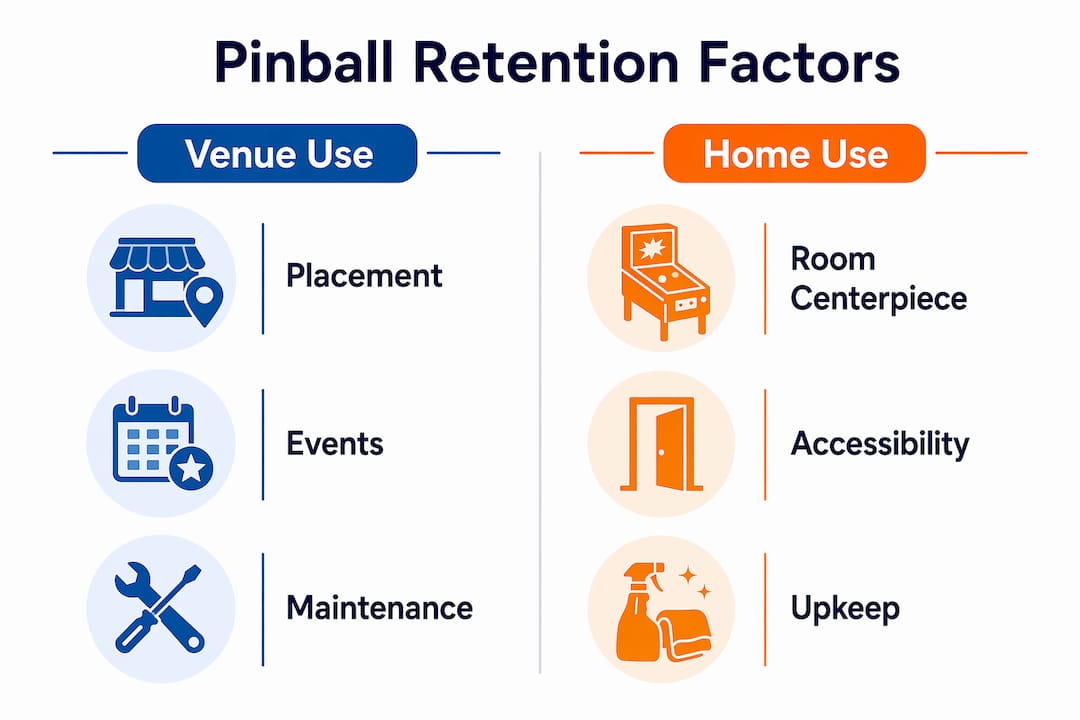
Placement is the single highest-leverage decision you will make. A machine tucked in a corner loses most of its social-anchor value. Position machines as islands in high-traffic zones, ideally visible from the entrance and adjacent to bar or seating areas.

| Placement Factor | High-Retention Setup | Low-Retention Setup |
|---|---|---|
| Visibility | Faces entrance or main floor | Tucked in corner or back wall |
| Adjacency | Near seating, bar, or queue | Isolated from social areas |
| Lighting | Backglass lit, area well-lit | Dim or obscured |
| Leaderboard display | Visible to passersby | Screen faces wall |
Pay model choices shape retention differently depending on your venue:
- Free-play (included in cover or membership) maximizes dwell time and social play but reduces per-play revenue tracking.
- Pay-to-play (coin or card) creates natural data on plays per session and revenue per machine, making ROI measurement straightforward.
- Card/house-credit systems reduce friction, encourage longer sessions, and integrate with loyalty programs.
For event strategy, running predictable tournament schedules creates habit loops. A weekly Thursday night tournament, promoted on a chalkboard and your social channels, gives regulars a standing appointment. Pair it with an F&B special and the cross-promotion reinforces both the gaming and the spend.
Pro Tip: Partner with a venue that already runs structured events, like tournament programming at Q Billiards Arena, to see how predictable scheduling builds a loyal weekly crowd. The same principle applies directly to pinball nights.
How home collectors and buyers create lasting retention value
For home buyers, the placement logic is just as important as it is for venues. A machine positioned as a room centerpiece, visible from a living or entertaining space, draws guests toward it naturally. Traffic flow matters: if guests have to seek the machine out, it plays less.
The play-versus-display trade-off is real. Vintage and collector titles carry prestige and long-term collector appeal, but a machine that never gets played loses its social value quickly. The most satisfying home setups balance both: a title with enough visual drama to anchor the room and enough rule depth to reward repeated play.
Practical steps for maximizing home retention:
- Position the machine where guests naturally gather, not in a dedicated room they rarely enter.
- Keep a high-score log on a notepad or whiteboard nearby to spark friendly competition.
- Schedule a monthly “high-score night” with friends to create a recurring social event.
- Maintain the machine on a simple quarterly schedule (rubbers, cleaning, flipper check) so it is always ready to play.
Pro Tip: A machine that is always ready to play gets played. A machine that needs a repair sits silent. Budget 30 minutes per quarter for basic upkeep and your guests will never know the difference.
How to measure pinball’s impact and calculate realistic ROI
Start with five primary KPIs before you invest, then track them over a 60–90 day test period:
- Dwell time: Average minutes per visit before and after installation.
- Repeat visit rate: Percentage of customers who return within 30 days.
- Plays per machine per day: Tracked via card system, coin counter, or manual log.
- F&B attach rate: Average food and beverage spend on days with high machine activity vs. low.
- Average revenue per user (ARPU): Total revenue divided by unique visitors per period.
A simple ROI frame: add direct machine earnings to the incremental F&B and secondary spend attributable to longer dwell time, subtract machine cost and maintenance, and divide by monthly net to get your payback period. Ownership cost data from Premiumpinballs can anchor the cost side of that calculation.
For used machines, request play and earnings logs where available. A machine with documented “legs” gives you a real performance baseline rather than a forecast, which is a meaningful advantage when justifying the purchase to a business partner or investor.
Modern telemetry systems track every play session in real time, letting operators identify dead zones, optimize placement, and predict maintenance needs before a machine goes dark — turning gut-feel floor management into data-driven decisions.
What to prioritize when buying a machine for maximum retention
Feature depth drives replayability. A machine with a shallow rule set gets mastered quickly and loses its pull. Prioritize titles with layered objectives, multiball modes, and skill shots that reward experienced players while remaining accessible to newcomers.
Key selection criteria:
- Rule depth and skill curve: The best retention titles take dozens of plays to fully understand.
- Multiplayer and competitive modes: Side-by-side play and head-to-head scoring extend sessions.
- Connected leaderboards: Modern pinball technology with networked score tracking adds a persistent competitive layer.
- Aesthetic draw: Custom artwork and a striking backglass do passive marketing work on your floor.
For the new-vs.-refurbished decision, refurbished machines offer a lower entry cost with proven mechanical reliability, while new titles bring current themes and factory warranties. Vintage machines carry collector prestige but require more specialized service. The right choice depends on your budget, your audience, and how central the machine is to your retention strategy.
Pro Tip: Check that any machine you buy is payment-system ready or can be upgraded. Card and tap-to-play systems generate the play-count data you need to measure ROI accurately from day one.
Maintenance and uptime best practices that protect your retention investment
A machine that is down for repair is a machine that is not building loyalty. Uptime is a retention variable, not just an operational one.
Every day a machine sits dark, you lose not just revenue but the habit loop you worked to build. Players who arrive for their weekly game and find an “Out of Order” sign often do not come back that week — and some do not come back at all.
Quarterly maintenance checklist:
- Clean the playfield surface and clear debris from under ramps and targets.
- Inspect and replace worn rubber rings on bumpers and flippers.
- Check all LED and bulb functions; replace any that are out.
- Test flipper strength and adjust coil stops as needed.
- Clean and test coin mechanisms or card readers.
For commercial operators, budget for a preventive service visit at least twice a year from a certified technician, and keep a small inventory of common spare parts (rubbers, fuses, flipper coils) on-site for quick fixes. Customer service and maintenance support directly affects how consistently your machine earns and retains players. A visible, well-maintained machine with a current leaderboard signals to players that the venue takes the experience seriously.
Key Takeaways
Pinball increases retention when placed intentionally, maintained consistently, and supported with events that create habit loops for players.
| Point | Details |
|---|---|
| Place for visibility | Position machines in high-traffic, socially visible zones to maximize spectator and group play. |
| Choose deep rule sets | Titles with layered objectives and skill curves keep players returning to improve their scores. |
| Track a 60–90 day test | Measure dwell time, repeat visits, and plays per machine before and after installation. |
| Budget for uptime | Quarterly maintenance and a spare-parts inventory protect the habit loop and revenue stream. |
| Use Premiumpinballs | Premiumpinballs offers curated new, refurbished, and used machines with commercial warranties and delivery support across the U.S. |
Why pinball’s retention value is consistently underestimated
The conventional wisdom treats pinball as a nostalgia play, a charming throwback that draws a smile and then gets ignored. That framing misses what actually happens on a well-run venue floor. The machines that generate the most consistent loyalty are not the newest or the flashiest. They are the ones positioned where people gather, maintained so they never go dark, and supported by a tournament calendar that gives regulars a reason to show up on a specific night every week.
Collectors face a version of the same blind spot. A machine displayed in a dedicated game room that guests rarely enter is a beautiful object that does almost nothing for social retention. Move it to the living room, keep a high-score log on the wall, and suddenly it becomes the reason people come over. The physical, tactile nature of pinball creates a kind of engagement that no streaming service or console game can replicate in a social setting, and that distinction is what makes it a genuinely durable retention asset rather than a trend.
Premiumpinballs has the machines and support to make it work
The practical gap between knowing pinball drives retention and actually capturing that value comes down to machine selection, condition, and ongoing support. Premiumpinballs bridges that gap with a curated inventory of commercial-grade pinball machines spanning new, refurbished, and used titles, each with detailed listings, transparent pricing, and warranty coverage designed for operators who cannot afford downtime.
For home collectors, the best home arcade machines selection includes titles with the rule depth and visual presence that turn a game room into the most popular room in the house. For commercial buyers, Premiumpinballs offers wholesale options, delivery and in-store pickup across the U.S., and after-sales support that keeps your machines earning. Browse the current inventory or reach out directly for a commercial consultation at premiumpinballs.com.
Useful sources and resources
Industry and market research:
- Pinball Machines Market — MarketIntelo: Market drivers and venue-level retention benefits for U.S. operators.
- How Game Rooms Provide Additional Revenue — Betson: Operator-level data on dwell time and F&B uplift.
- Jersey Jack — RePlay Magazine: Operator insights on ROI, earnings history, and route models.
- Why Pinball Machines Are Making a Comeback — Blee Amusement: Nostalgia, skill, and revenue reliability factors.
- What Tabletop Games Bring to Leisure Venues — Amusements & Attractions: Placement and event programming evidence.
- Pinball vs. Claw Machines — Xiyu Technology: Customer type and ARPU dynamics comparison.
Premiumpinballs resources:
- Why Pinball Machines Elevate Bars: Engagement, event programming, and warranty support for operators.
- Must-Have Pinball Features: Feature checklist for buyers focused on retention outcomes.
- Pinball Machine Ownership Cost: Total cost of ownership and maintenance budgeting data.
- Advantages of Refurbished Pinballs: Value proposition for operators seeking proven earnings history.