
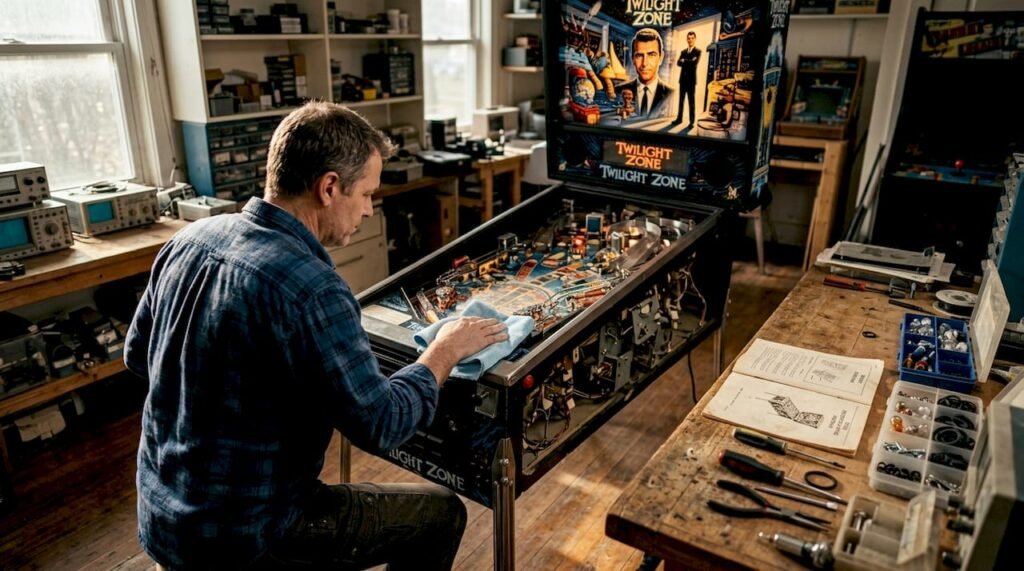
Slapping a “refurbished” label on a pinball machine does not automatically unlock a higher price tag. Serious collectors know the difference between a machine that received a genuine mechanical overhaul and one that simply got a fresh coat of paint and a wipe-down. In fact, poorly documented restorations are actively distrusted in the secondary market, and sellers who misuse the “restored” label without thorough mechanical work often find their listings sitting unsold. This guide cuts through the noise and explains exactly how refurbishing affects resale value, what collectors scrutinize, and how you can position any machine for maximum return.
Table of Contents
- What does refurbishing mean in pinball resale?
- How does refurbishing affect pinball resale value?
- Essential documentation for maximum resale
- What collectors look for in refurbished pinballs
- Why full transparency beats “like new” claims every time
- Where to find trustworthy refurbished pinball machines
- Frequently asked questions
Key Takeaways
| Point | Details |
|---|---|
| Documentation is critical | Sales records, photos, and service receipts build trust and boost resale value. |
| Full refurbishments win | Mechanical and cosmetic restoration backed by proof is worth more than surface-level work. |
| Collectors value transparency | Buyers pay a premium for machines with verifiable refurbishment and clear histories. |
| Avoid overselling claims | Calling a pinball ‘restored’ without evidence or real upgrades may hurt—as much as help—resale potential. |
What does refurbishing mean in pinball resale?
While most believe the “refurbished” label automatically signals a premium product, let’s clarify what real refurbishment means in practice. In the pinball world, the terms “refurbished,” “restored,” and “cosmetically fixed” are not interchangeable, yet sellers routinely treat them as if they are. That confusion costs money.
Refurbishment refers to a broad process of bringing a machine back to reliable, enjoyable playing condition. It typically covers both mechanical and cosmetic elements. Restoration, by contrast, implies a more thorough, often period-correct return to original factory condition, including sourcing original parts and preserving authentic artwork. Cosmetic fixes are the lightest touch: cleaning, polishing, and surface-level repairs that do nothing for the electronics or playfield mechanisms underneath.
When you browse refurbished pinball basics or research the meaning of refurbished in the collector market, you will find that buyers expect a meaningful scope of work before trusting any premium price. The community standard is clear: sellers avoid the “restored” label without documented mechanical work to back it up.
Here is what genuine refurbishment should cover:
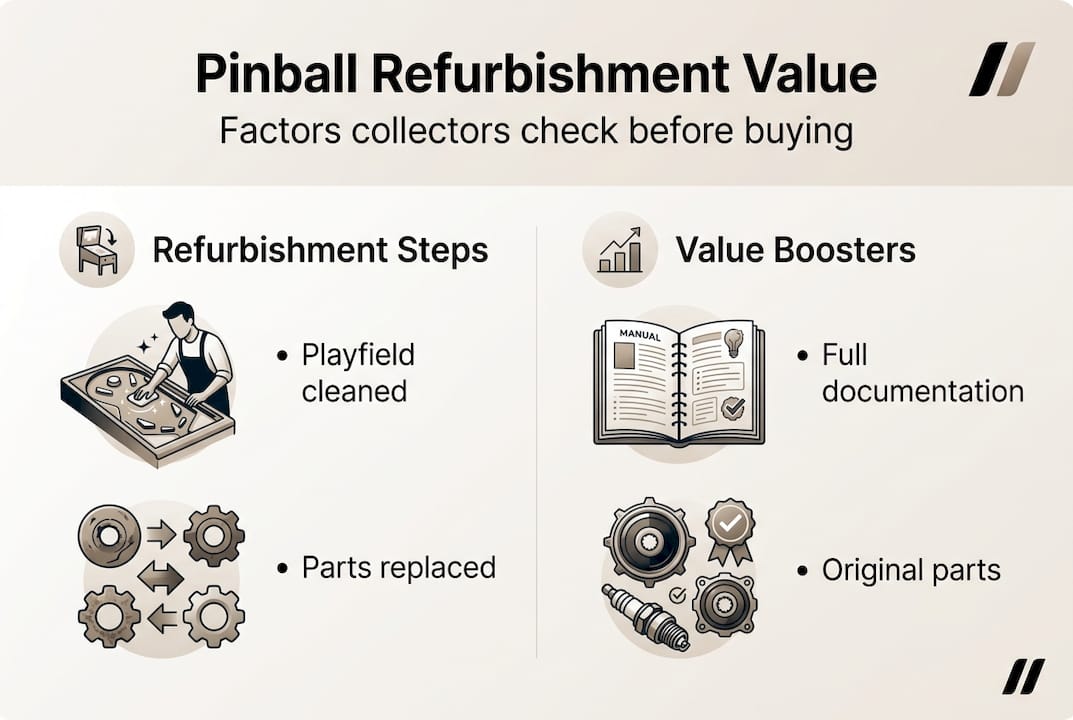
- Playfield: Cleaning, waxing, and replacing worn inserts or plastics
- Electronics: Inspecting and repairing circuit boards, replacing capacitors, and testing all solenoids
- Mechanical parts: Rebuilding flippers, replacing worn rubber rings, and servicing pop bumpers
- Display and lighting: Upgrading or restoring the display, replacing burned-out bulbs or adding LED kits
- Cabinet: Repairing or replacing decals, touching up paint, and fixing any structural damage
- Documentation: Compiling receipts, work logs, and before-and-after photos
Common missteps include cleaning the cabinet exterior while ignoring a failing power supply, or replacing rubber rings without addressing a corroded playfield. These shortcuts are easy for experienced collectors to spot, and they erode trust fast. Understanding why choose refurbished machines also means understanding what separates a genuine upgrade from a cosmetic disguise.
Pro Tip: Before listing any machine as refurbished, play through a full game and document every component you touched. If you cannot show your work, buyers will assume the worst.
How does refurbishing affect pinball resale value?
Now that we have defined what counts as meaningful refurbishment, let’s look at how that translates into dollars and trust in the market. The impact on resale value is real, but it is not automatic. Quality and transparency are the two levers that move the needle.
Here is a side-by-side look at how condition and documentation affect typical resale outcomes:
| Condition | Documentation | Typical resale outcome |
|---|---|---|
| Unrestored, original | Minimal | Baseline market price, collector interest for originality |
| Cosmetic-only fixes | Partial or none | Equal to or below unrestored; buyer skepticism high |
| Full mechanical refurb | Thorough records | Premium pricing, faster sale, stronger collector appeal |
| Over-restored, non-original parts | Mixed | Reduced collector value; may appeal to players only |
The table tells a clear story. A machine with full mechanical refurbishment and thorough documentation commands the strongest position. Cosmetic-only work, however, often performs worse than an honest unrestored machine because buyers distrust superficial refurbishments without proof of mechanical integrity.
Transparency supports premium pricing in several concrete ways:
- Buyers feel confident they are not inheriting hidden problems
- Detailed records reduce negotiation friction and price haggling
- A documented machine is easier to insure and finance
- Provenance adds a layer of prestige that purely cosmetic work cannot replicate
Pitfalls that actually decrease perceived value include using non-original parts without disclosure, over-polishing a playfield to the point of erasing original artwork, or replacing original boards with aftermarket alternatives without noting it. Understanding pinball machine values means recognizing that authenticity and honesty carry real weight. The benefits of refurbishment only materialize when the work is both thorough and verifiable.

Essential documentation for maximum resale
A machine’s real value is not just in the physical upgrades, but also in what you can prove about its history. Documentation is the bridge between the work you did and the price you deserve.
Here is a numbered checklist of everything you should compile before listing a refurbished machine:
- Service records: A written log of every repair session, including dates and the technician’s name
- Parts receipts: Invoices for every component purchased, from flipper coils to LED kits
- Work scope summary: A plain-language description of what was done and why
- Before-and-after photos: High-resolution images of the playfield, cabinet, and electronics before work began and after completion
- Original manuals and schematics: These reassure buyers that the machine can be serviced correctly in the future
- Seller contact availability: Offering to answer post-sale questions signals confidence in your work
“Detailed photos and maintenance records are key for resale.” The collector community rewards transparency and penalizes vagueness. A seller who can show their work commands respect and, more importantly, a better price. (Pinside)
Common mistakes that undermine resale include listing a machine as refurbished with only a single photo, omitting which parts were replaced, or failing to disclose known issues that were not addressed. Buyers who feel misled leave negative feedback and, in private collector circles, that reputation spreads quickly.
A thorough pinball purchase checklist protects both buyer and seller. Consulting a pinball valuation guide helps you price confidently, and understanding grading refurbished pinballs ensures you present your machine at the right tier.
Pro Tip: Organize your documentation into a single digital folder and offer it as a downloadable link in your listing. Buyers who see a complete package move faster and negotiate less.
What collectors look for in refurbished pinballs
Documentation is vital, but collectors apply their own unique checklist when judging a machine’s true worth. Understanding buyer psychology is just as important as the physical work itself.
Here is what attracts serious collectors to a refurbished machine:
- Originality preserved: Collectors prize machines where original artwork, boards, and mechanical parts are retained wherever possible
- Honest condition grading: A machine graded accurately, even if it has minor flaws, earns more trust than one oversold as perfect
- Playfield integrity: No lifting inserts, no clearcoat cracks, no worn-through artwork under the ball paths
- Electrical reliability: Clean wiring harnesses, no burned connectors, and tested boards with no intermittent faults
- Matching serial numbers: Original boards and roms matching the machine’s documented history
Red flags that repel collectors include non-original replacement playfields, missing original plastics replaced with reprints without disclosure, and cabinet art that has been repainted rather than restored. Poor or cosmetic-only restorations are consistently distrusted, and sellers who use the “restored” label without a thorough overhaul face pushback and low offers.
Here is how specific features affect collector value:
| Feature or condition | Effect on value |
|---|---|
| Original playfield, professionally cleaned | Strong positive |
| Reproduction playfield, disclosed | Neutral to slight negative |
| LED upgrade with original boards retained | Positive for player buyers |
| Non-original boards, undisclosed | Significant negative |
| Full parts receipts included | Strong positive |
| Cabinet repaint without disclosure | Moderate negative |
Understanding collector standards and the nuances of pinball price factors gives sellers a decisive edge. For hardware restoration specifics, hardware restoration care offers useful guidance on preserving original finishes and metal components that collectors inspect closely.
Why full transparency beats “like new” claims every time
Having explored the technical and documentation side, let’s address the most common and costly misconception about selling refurbished pinballs: the belief that bold marketing language substitutes for verifiable proof.
We see it constantly. A seller describes a machine as “fully restored, like new, plays perfectly” with three blurry photos and no receipts. Experienced collectors scroll past immediately. The phrase “like new” triggers suspicion rather than excitement in a market where buyers have been burned before. Collector trust is built on verification, not sales language.
The uncomfortable truth is that a machine honestly described as “good player condition with documented flipper rebuild and new rubbers” will often sell faster and closer to asking price than one oversold with vague superlatives. Specificity signals competence. Vagueness signals risk.
Our perspective, grounded in years of watching this market, is that true refurbished value is always earned through transparency. Every claim you make about a machine should be backed by something a buyer can see, read, or verify independently. That is the standard the collector community holds, and it is the only path to premium resale returns.
Where to find trustworthy refurbished pinball machines
If you are looking to buy or sell refurbished machines with full confidence, here is how to make it happen.
At Premium Pinballs, we believe that every refurbished machine deserves a full story, not just a fresh exterior. Our inventory is curated with the collector’s eye in mind, featuring machines that meet rigorous standards for both mechanical integrity and honest documentation. Whether you want to shop high-quality refurbished machines, understand refurbished standards before you commit, or simply browse refurbished machines across iconic titles, we are here to guide every step of your journey with the transparency and prestige you deserve.
Frequently asked questions
What counts as a true refurbishment for pinball machines?
A true refurbishment means both mechanical and cosmetic restoration with full documentation and verifiable work, not just surface fixes. Sellers avoid the “restored” label without complete mechanical work to support it.
How do you prove a pinball machine was properly refurbished?
Provide detailed maintenance records, before-and-after images, work receipts, and a list of replaced parts to verify refurbishment. Detailed photos and records are the gold standard for resale confidence.
Does cosmetic-only restoration increase a pinball’s resale value?
Cosmetic-only restoration rarely increases value and may make collectors wary unless all mechanical needs are addressed. Cosmetic-only restorations are consistently distrusted by experienced buyers in the secondary market.
Why do collectors ask for documentation when buying refurbished?
Because thorough documentation proves work quality and reassures buyers, reducing the risk of future problems. Documentation is key for building resale confidence among serious collectors.