
TL;DR:
- Provenance verifies a pinball machine’s authenticity, worth, and long-term reliability through documented ownership and service records. Matching serial numbers, detailed photos, and restoration documentation significantly increase a machine’s market value and buyer confidence. Buyers should request comprehensive photos, serial verification from multiple locations, and detailed restoration portfolios before purchasing, especially in remote transactions.
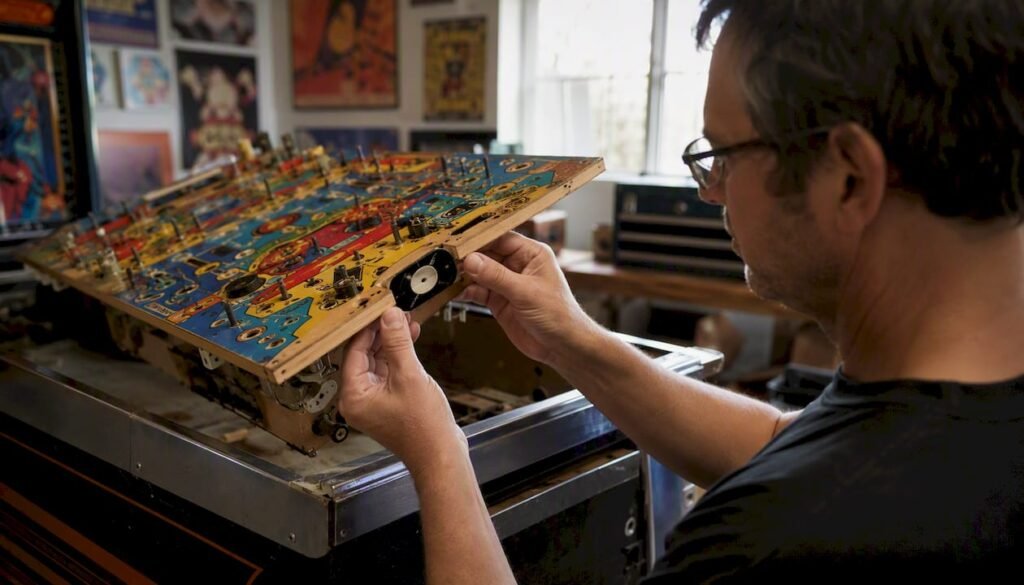
Provenance, in the pinball world, is the documented chain of ownership, serial verification, and service history that determines what a machine is actually worth — and whether you can trust what a seller tells you. Before you commit to any purchase, whether from a private collector, a reseller, or a platform like Premiumpinballs, three things should land in your inbox first: serial-location photos matching the Internet Pinball Database records for that title, high-resolution playfield and backglass images, and dated service receipts showing any recap or restoration work. Williams and Bally machines, which dominate the collector market, carry manufacturer stamps in multiple locations precisely because matching those stamps is the fastest authenticity check available.
Immediate provenance checklist for any listing:
- Serial-location photos (cabinet interior, backbox, playfield underside)
- High-resolution photos of playfield, backglass, coin door, and boards
- Dated service or restoration receipts
- Evidence of recapped driver and power supply boards (uniform new capacitors)
Pro Tip: Ask for these items before you ask the price. A seller who hesitates on documentation is telling you something important.
Table of Contents
- What provenance covers for a pinball machine
- How to verify serial numbers across cabinet, backbox, and playfield
- What photos and video buyers should always request
- How to evaluate restoration quality from documentation
- How provenance affects market value and what documentation commands a premium
- A ready-to-use checklist of questions and documents to request
- Best practices for remote purchases: escrow, inspection, and shipping
- How Premiumpinballs documents machines before listing
- Key Takeaways
- Why provenance is the most underestimated factor in pinball collecting
- Premiumpinballs: provenance-verified machines, ready to buy
- Useful sources
What provenance covers for a pinball machine
Provenance is not a single document. For a transaction to hold up under scrutiny, it encompasses ownership paperwork, serial verification, dated service and restoration records, a photo and video record, and any operational logs the previous owner maintained.
Each element serves a distinct purpose. Ownership paperwork establishes the chain of custody and supports insurance claims. Serial verification confirms the machine has not been assembled from mismatched parts. Dated service records let buyers forecast maintenance costs and identify whether critical electrical work has already been done. Photo and video documentation gives remote buyers a forensic view of condition. Operational logs, increasingly common among seasoned collectors, track firmware versions, switch adjustments, and part replacements over time.
| Document or Record | What It Confirms | Why Buyers and Operators Care |
|---|---|---|
| Ownership paperwork / bill of sale | Chain of custody | Supports insurance, resale, and authenticity claims |
| Matching serial stamps | Part originality | Detects swapped cabinets, playfields, or backboxes |
| Dated service / restoration receipts | Maintenance history | Forecasts future costs; confirms recap and flipper work |
| High-res photo / video package | Visual condition | Enables remote evaluation without physical inspection |
| Operational log / maintenance logbook | Ongoing care record | Improves resale pricing; reduces operator downtime |
Appraisal guides consistently list documentation and matching numbers among the primary determinants of collectible pinball value. One important caveat: “Documented HUO” (home use only) is widely debated in collector communities — absolute proof of exclusive home use is rare. Treat it as “documented lower-play exposure” and let condition plus supporting paperwork carry the argument.
How to verify serial numbers across cabinet, backbox, and playfield
Matching serial stamps are the single most powerful authenticity signal a pinball machine can carry. Williams and Bally, the two manufacturers whose titles define the golden era of collecting, traditionally stamped serial numbers in three locations: the interior rear of the cabinet, the backbox (head), and the underside of the playfield. All three should match.
Step-by-step serial verification:
- Request a photo of the cabinet interior rear wall, showing the full serial tag with legible font and no shadow.
- Request a photo of the backbox interior, specifically the serial stamp or sticker on the head panel.
- Request a photo of the playfield underside, taken with a flashlight at an angle to reveal the stamped or stickered serial clearly.
- Cross-reference all three against the Internet Pinball Database entry for that title to confirm the serial range is consistent with the stated production year.
- Compare font style, stamp depth, and label condition across all three photos. Mismatched fonts, obvious re-stamping, or paint over a serial location are immediate red flags.
- If anything conflicts, request the original distributor paperwork or bill of sale before proceeding.
Red flags worth escalating: serials that appear freshly painted around, labels that look newer than the surrounding cabinet, or stamps with inconsistent character spacing. These suggest part swaps that affect pinball machine authenticity and resale value.
Pro Tip: When you receive serial photos, rename each file immediately with a timestamp and location tag (e.g., AFMR_serial_cabinet_20260312.jpg). Preserve the original EXIF data. This creates a chain-of-custody record that supports insurance claims and future resale.
What photos and video buyers should always request
Marketplace best practices make clear that comprehensive imaging is the foundation of any sight-unseen purchase. A seller who provides a handful of wide shots is not giving you enough to make a confident decision.
| Shot Name | What to Show | Recommended File Name Pattern |
|---|---|---|
| Playfield full | Complete playfield, overhead, well-lit | [title]_playfield_full.jpg |
| Playfield wear zones | Close-ups of flipper area, drain, and ramps | [title]_playfield_wear_[zone].jpg |
| Backglass | Full backglass, no glare, natural color | [title]_backglass.jpg |
| Cabinet sides | Both sides, full length | [title]_cabinet_L.jpg / _R.jpg |
| Serial stamps | All three locations (see section above) | [title]_serial_[location].jpg |
| MPU / driver board | Board face showing capacitors | [title]_board_MPU.jpg |
| Power supply board | Full board, capacitors visible | [title]_board_PSU.jpg |
| Coin door | Interior and exterior | [title]_coindoor.jpg |
| Self-test video | Machine running through self-test mode | [title]_selftest.mp4 |
Request images in the highest resolution the seller can provide, preferably uncompressed JPEGs or PNGs with EXIF intact. Video self-tests and board close-ups are increasingly expected in quality listings because they reduce disputes and returns on sight-unseen sales.
Pro Tip: Ask sellers to compile their documentation into a single restoration portfolio PDF with dated receipts and before/after photos. A well-organized portfolio signals a seller who understands the machine’s value and has maintained it accordingly.
How to evaluate restoration quality from documentation
Not every “restored” machine deserves that label. The difference between a genuine restoration and a cosmetic touch-up shows up clearly in the documentation and photos, if you know what to look for.
Mechanical indicators of quality restoration:
- Rebuilt flippers with new coils, sleeves, and correct fasteners
- Clean, corrosion-free boards with uniform new capacitors (evidence of professional recapping)
- OEM-correct reproduction parts where originals were unavailable
- Clean switch contacts and properly tensioned leaf switches
- Consistent, matching screws throughout (stripped heads signal rushed work)
Red flags that predict future costs: sloppy or bundled wiring, non-uniform capacitors on boards that were not recently recapped, mismatched screws, and playfield touch-ups that don’t match the original artwork color profile. These are not cosmetic concerns — they indicate deferred maintenance.
When reading service invoices, trust specific terminology: “recapped driver board,” “rebuilt flipper assemblies,” “replaced opto boards.” Be skeptical of vague phrases like “fully restored” or “museum-grade” without itemized receipts to support them. A pinball restoration checklist can help you map claimed work against what the photos actually show.
Pro Tip: For any machine priced above $3,000, insist on a third-party inspection report or a live video walkthrough with a technician present before transferring funds.
How provenance affects market value and what documentation commands a premium
Documented provenance lifts a machine’s market value in concrete, measurable ways. Restoration portfolios — PDFs documenting every part replaced and every repair performed — can allow sellers to ask for a 15–20% premium over machines with no documented history. That gap widens further when the documentation includes matching serials, original manuals, and keys.
The documents that command the highest premiums, in rough order of buyer impact:
- Matching serial stamps across all three locations
- Itemized restoration receipts with dates and restorer names
- Photographic evidence of recapped driver and power supply boards
- Original manuals, keys, and distributor invoice
- Dated in-home or in-venue photos establishing the ownership chain
Sellers who want to maximize perceived value should present documentation in a logical sequence: serial verification first, then the restoration portfolio, then operational logs. Buyers pay for confidence, and confidence comes from a story they can verify. For collectors weighing pinball collection value against acquisition risk, a well-documented machine is simply a safer asset.
A ready-to-use checklist of questions and documents to request
Documents and photos to request before any purchase:
- Serial-location photos (cabinet, backbox, playfield underside)
- High-resolution playfield, backglass, and cabinet photos
- MPU, driver board, and power supply board photos showing capacitor condition
- Dated service and restoration receipts with itemized work
- Self-test video showing all features functional
- Original sales paperwork, distributor invoice, or bill of sale if available
- Any operational logbook or maintenance log
Step-by-step request sequence:
- Send an initial message requesting serial photos and a self-test video.
- Follow up with a request for the full photo package and restoration receipts.
- Review all materials against the IPDB entry and cross-check serial ranges.
- If anything conflicts or is missing, request distributor confirmation or an independent inspection before proceeding.
- Agree on a timeline: sellers should respond to documentation requests within 48–72 hours.
A simple opening message: “Hi — I’m very interested. Before we discuss price, could you send serial photos from the cabinet, backbox, and playfield underside, plus a self-test video and any service receipts you have? Happy to move quickly once I’ve reviewed those.” This framing is professional, signals you know what you’re doing, and filters out sellers who cannot or will not provide documentation. A purchase checklist can help you track what you’ve received and what remains outstanding.
Best practices for remote purchases: escrow, inspection, and shipping
Remote purchases carry real risk, and the right controls reduce it substantially.
Risk controls for remote transactions:
- Use an escrow service for any purchase above $2,000; release funds only after delivery confirmation and a brief inspection period.
- Require a third-party inspection report or a live video walkthrough with a technician before committing.
- Retain a portion of payment until the machine arrives and powers on successfully.
- Request packing photos before the machine ships, showing how it was prepared for transport.
- Require the carrier to document pre-loading condition with photos.
For shipping, insured transport is non-negotiable. Pinball machines are heavy, fragile, and expensive to repair if damaged in transit. Confirm the carrier’s claims process before booking, and verify that your provenance documentation (photos, receipts, serial records) is sufficient to support a damage claim if needed. Moving a pinball machine safely requires proper crating, leg removal, and glass protection — details worth confirming with the seller before the machine leaves their location.
Pro Tip: Commercial operators managing a fleet should integrate each machine’s provenance records into a per-unit maintenance log that travels with the machine between locations. Firmware versions, switch adjustments, and part replacement dates belong in that log — it materially improves resale pricing and reduces diagnostic time when a machine moves.
How Premiumpinballs documents machines before listing
Premiumpinballs follows a structured documentation process before any machine reaches its listing page.
Documentation steps for every machine:
- Initial physical inspection covering cabinet, playfield, backglass, and all mechanical assemblies.
- Serial verification across cabinet, backbox, and playfield underside, with photos captured at each location.
- High-resolution photo and video package produced, including self-test footage and board close-ups.
- Restoration portfolio collated from all service receipts, parts invoices, and restorer notes.
- Electrical board inspection confirming recap status on driver and power supply boards.
- Final condition report prepared and attached to the product listing.
Trust signals included with Premiumpinballs listings:
- Scanned distributor invoice when available
- Itemized restoration receipts with dates
- Downloadable restoration portfolio PDF on the product page
- High-resolution photo package covering all key areas
Buyers who want additional verification or an in-person inspection before purchase can contact Premiumpinballs directly through the website. The team accommodates bespoke verification requests and bulk or operator inquiries. Explore the full range of refurbished pinball machines to see how documentation standards translate into buyer confidence at every price point.
Key Takeaways
Provenance is the single most reliable predictor of pinball machine value, authenticity, and long-term usability — verify serials, demand board photos, and never skip documentation.
| Point | Details |
|---|---|
| Verify all three serial locations | Cabinet, backbox, and playfield underside stamps must match to confirm part originality. |
| Demand recapped board evidence | Uniform new capacitors on driver and power supply boards reduce failure risk and support a price premium. |
| Request a restoration portfolio | Documented restorations can command a 15–20% price premium over undocumented machines. |
| Use escrow for remote purchases | Release funds only after delivery confirmation and a brief inspection period to protect against fraud. |
| Premiumpinballs as your benchmark | Every Premiumpinballs listing includes serial verification, board inspection, and a downloadable restoration portfolio. |
Why provenance is the most underestimated factor in pinball collecting
Most buyers focus on title and cosmetics. The machine looks great in the photos, the playfield art is intact, and the price feels right. What they miss is that a machine without documentation is a machine with an unknown future — and unknown futures are expensive.
The collector community has spent years debating what “documented” really means, and the honest answer is that no single document proves everything. What provenance actually does is shift the burden of proof. A machine with matching serials, recapped boards, and itemized restoration receipts forces a skeptic to find a reason to doubt it. A machine with none of those things forces a buyer to find a reason to trust it. That asymmetry is where value lives.
Sellers who invest in documentation are not just protecting their asking price. They are making the next transaction easier for whoever buys the machine after you. That chain of care is what separates a collectible from a commodity, and it is why the most sophisticated buyers in this market treat provenance as a prerequisite, not a bonus.
Premiumpinballs: provenance-verified machines, ready to buy
Premiumpinballs gives buyers something most private listings cannot: a documented machine with a transparent history, ready to evaluate before you commit. Every listing on the platform comes with serial verification, board inspection records, and a restoration portfolio — the exact documentation this guide recommends you demand from any seller.
For collectors seeking a specific title, operators building a fleet, or resellers who need machines they can confidently pass on, Premiumpinballs offers arcade-ready pinball machines with the paperwork to back them up. Contact the team directly for bespoke verification, bulk pricing, or to request additional documentation on any listed machine. Browse current inventory and request your restoration portfolio today.
Useful sources
- Pinball Seller’s Checklist (Pinside) — Community-sourced checklist of what sellers should provide; covers photo requirements, serial documentation, and remote-buyer best practices.
- No Such Thing as Documented HUO? (Pinside) — Forum thread examining the limits of “home use only” claims and what documentation actually proves.
- Pinball Restoration ROI Guide (Calcix) — Analyzes the value lift from documented restorations, including the 15–20% premium restoration portfolios can support.
- Antique Pinball Machine Value Guide (Appraisily) — Appraisal framework covering how documentation, matching numbers, and condition interact to determine market value.
- Post-Purchase Checklist (PinWiki) — Practical post-purchase steps including serial recording, photo documentation, and adding machines to the Internet Pinball Serial Number Database.
- Internet Pinball Database (IPDB) — The authoritative reference for serial number ranges, production years, and title specifications; essential for cross-checking seller claims.
- Pinball M on PickThe.Games — Platform and title catalog useful for identifying model variants and confirming game specifications before purchase.