
TL;DR:
- Customer service in arcades drives repeat revenue and is a key financial priority for venues. Personalized interactions, membership programs, and reliable equipment significantly boost guest retention and spending. Effective after-sales support and group experiences further enhance revenue and guest satisfaction in family entertainment centers.
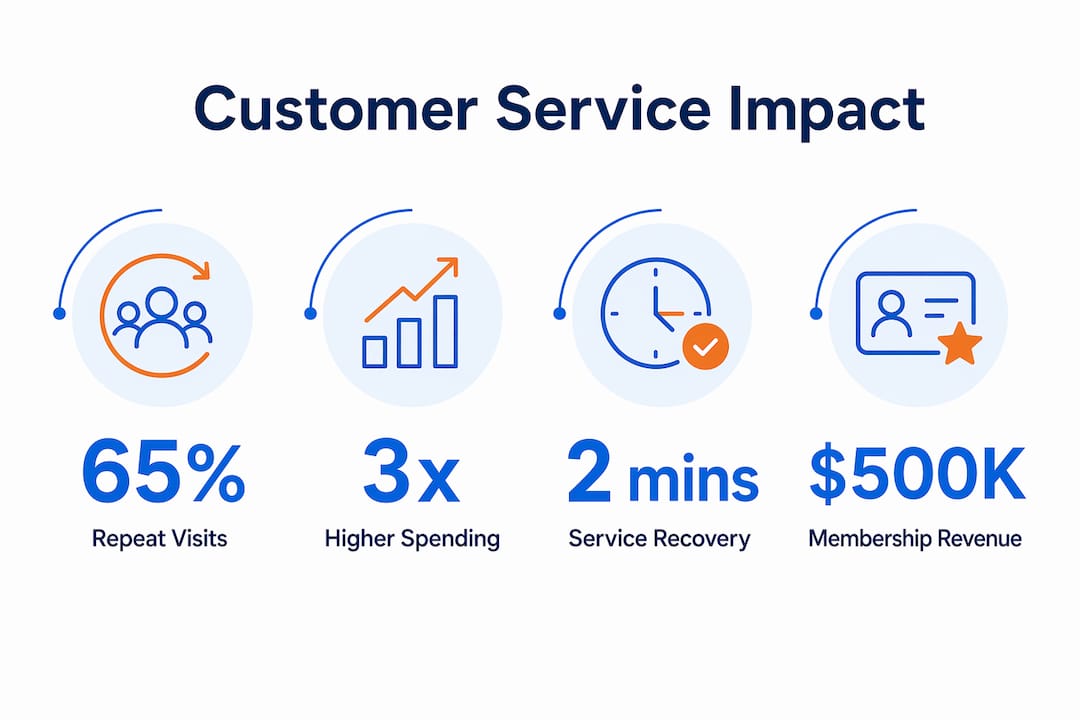
Customer service is the single greatest driver of repeat revenue in arcade venues. 65% of family entertainment center revenue comes from repeat visitors, and acquiring a new customer costs five times more than keeping an existing one. That math makes the role of customer service in arcade sales not just a hospitality concern but a direct financial priority. Venues that treat every guest interaction as a revenue event, from the front desk greeting to post-visit follow-up, consistently outperform those that focus only on machine selection and floor layout.
How does quality customer service enhance guest retention and spending?
Loyal guests spend more. Repeat customers are 3 times more likely to spend than first-time visitors. That gap in spending behavior means your floor staff, your ticketing process, and your complaint resolution protocol are all revenue tools, not just operational overhead.
The most impactful service moments are often the smallest ones. A staff member who remembers a regular guest’s favorite game, or who resolves a machine malfunction in under two minutes without requiring a manager, creates a memory that competes with no advertisement. These micro-interactions build the kind of emotional connection that shapes unforgettable entertainment experiences and turns a one-time visitor into a monthly regular.
Personalization is the mechanism behind that loyalty. When staff recognize guests by name or preference, the venue shifts from a commodity to a destination. That shift directly affects how long guests stay and how much they spend per visit.
Key service behaviors that drive retention and spending:
- Greet returning guests by name when your point-of-sale system flags them as members.
- Resolve machine issues on the spot. Staff empowered to fix minor malfunctions independently reduce wait times and prevent frustration from compounding.
- Offer comp plays or bonus credits when a guest experiences a technical failure, rather than waiting for a formal complaint.
- Train staff to read the floor. A guest standing still and looking confused is a sales opportunity, not a background detail.
Pro Tip: Set a two-minute service recovery standard for machine malfunctions. Staff who resolve issues within that window consistently receive higher satisfaction scores and generate more repeat visits than venues with no defined response time.
What customer service systems and membership programs drive arcade sales growth?
Membership programs are the most measurable customer service investment an arcade venue can make. Data-driven membership and prepaid card systems with tailored game difficulty settings can increase annual arcade revenue by 40%–50%. That figure reflects not just more visits but higher per-visit spending driven by exclusive member incentives.
The mechanics behind that growth follow a clear logic:
- Enroll guests in a prepaid card program. Prepaid cards reduce friction at the point of play and encourage guests to load more credits than they intend to spend in a single visit, creating natural return visits to use remaining balances.
- Customize game parameters for members. Mismatched game difficulty and rewards cause churn. Members who face high difficulty with low prize thresholds leave. Members who experience low-threshold, high-reward settings return and recharge.
- Create member-only prize tiers. Exclusive redemption options available only to cardholders activate what operators call “cyclic consumption,” where guests return specifically to accumulate points toward a desirable reward.
- Run targeted recharge campaigns. Use member data to send personalized offers when a guest’s card balance drops below a set threshold. Timed promotions tied to birthdays or visit anniversaries outperform generic discounts.
| Service System | Primary Benefit | Revenue Impact |
|---|---|---|
| Prepaid card program | Reduces play friction, encourages balance top-ups | Increases per-visit spend |
| Member-only game settings | Improves retention through tailored difficulty | Reduces churn, boosts cyclic visits |
| Targeted recharge campaigns | Personalizes offers based on balance and behavior | Raises recharge frequency |
| Automated online booking | Handles off-season transactions without staff | Expands revenue beyond floor hours |
Automation extends this service model beyond your physical venue. One family fun center generated over $500,000 in additional online revenue in its first year by automating front-end sales and bookings, handling more than 8,630 transactions during the off-season alone. That revenue existed entirely outside normal operating hours.
Pro Tip: Link your prepaid card system to your arcade payment setup so member data flows automatically into your CRM. Manual data entry breaks the personalization loop that makes these programs profitable.
How does after-sales support affect arcade revenue and guest satisfaction?
After-sales support is the hidden cost that most arcade operators underestimate until a machine goes dark on a Saturday night. Poor after-sales support leads to extended machine downtime, and that downtime costs revenue repeatedly, not just once. The total ownership cost of an arcade machine is shaped more by service reliability than by its purchase price.
Equipment reliability and professional after-sales service are the top factors in guest satisfaction and revenue protection. A machine that breaks down and stays broken for a week does not just lose its own revenue. It signals to guests that the venue does not maintain its equipment, which erodes trust across the entire floor.
Service agreements that cover only hardware replacement miss the point. High-quality service agreements should include technical consultation, software updates, and spare parts availability. Software updates matter especially for machines with digital scoring, prize redemption integration, or membership card readers.
What a complete service agreement should cover:
- Hardware repair and parts replacement with defined response time commitments.
- Software updates for machines with digital interfaces, redemption systems, or card readers.
- Technical consultation when a machine’s performance metrics drop, not just when it fails completely.
- Remote diagnostics where available, to identify issues before they cause full downtime.
Understanding the full pinball machine ownership cost before you buy is the only way to budget accurately for service agreements. Operators who treat service as an afterthought consistently face higher total costs than those who negotiate support terms upfront.
How do group-oriented guest experiences affect arcade sales?
Group visits are the fastest-growing revenue segment in family entertainment centers. 53% of guests now prioritize unique group experiences over price-driven decisions, up from 39% in 2025. Shared emotional reactions, the collective gasp when someone nearly beats a high score, predict repeat visits more reliably than any individual satisfaction metric.
Customer service design for groups requires a different approach than solo guest service. Groups need simultaneous engagement. A venue where only one person can play at a time while others watch loses the group’s energy quickly. Shoulder-to-shoulder gameplay, where multiple guests interact with the same machine or adjacent machines in a shared challenge, holds groups longer and generates more spending per head.
Facility design acts as a silent salesperson. Well-designed floor flow and clear theming reduce guest anxiety, increase dwell time, and raise per-visit spend. Staff visibility within that layout reinforces the effect. A guest who can see a staff member nearby feels more comfortable asking for help, trying a new machine, or requesting a group package upgrade.
Service behaviors that support group experiences:
- Station staff near high-traffic group zones rather than behind a counter. Visible staff reduce hesitation and increase upsell opportunities.
- Offer group packages with bundled credits and reserved machine time. Groups that pre-commit to a package spend more than groups who pay per play.
- Design machine clusters for social play. Pinball machines placed in clusters of two or three invite competition and commentary between players, extending group dwell time naturally.
- Celebrate group milestones on the floor. A staff member who acknowledges a high score or a birthday in the moment creates a shareable memory that drives social referrals.
Key Takeaways
Customer service in arcade venues is a direct revenue driver, not a support function, and venues that invest in personalized interactions, membership systems, and reliable equipment consistently outperform those that do not.
| Point | Details |
|---|---|
| Repeat visitors drive most revenue | 65% of FEC revenue comes from repeat guests, making retention the top sales priority. |
| Membership systems boost annual revenue | Data-driven prepaid and membership programs can increase annual revenue by 40%–50%. |
| After-sales support protects revenue | Machine downtime costs more than the repair itself; service agreements must cover software and consultation. |
| Group experiences increase per-visit spend | 53% of guests prioritize group experiences, making social play design a direct sales tool. |
| Staff empowerment reduces friction | Staff who resolve issues independently improve satisfaction and reduce bottlenecks on the floor. |
What I’ve learned about service as a sales strategy in arcades
Most arcade operators I’ve spoken with think of customer service as damage control. Fix the broken machine, handle the angry parent, process the refund. That framing costs them money every single day.
The venues that grow year over year treat every guest interaction as a relationship investment. They know that a guest who leaves happy after a minor problem was resolved quickly is more loyal than a guest who had no problem at all. Service recovery, done well, creates stronger bonds than a flawless visit.
The detail that separates high-performing venues from average ones is not the machine selection or the prize wall. It is whether the staff knows the regulars, whether the membership program actually rewards loyalty in a way guests feel, and whether a machine breakdown gets fixed before the guest finishes their drink. Operational excellence at that level is not glamorous. It is, however, the most durable competitive advantage available to an arcade operator.
— Jim
Premiumpinballs: machines built for the guest experience you want to deliver
The quality of your machines is the foundation every customer service strategy rests on. A beautifully designed service program collapses the moment a guest sits down at a machine that plays poorly or breaks mid-game.
Premiumpinballs carries a curated selection of refurbished, used, and new pinball machines built for commercial arcade environments, including iconic titles like Addams Family, Attack From Mars, and Ghostbusters. Every machine in the inventory is backed by clear warranty terms and after-sales support, so your service agreements start from a position of strength. Explore the best pinball machines for arcades and find the titles that will anchor your floor, hold your groups, and give your staff something worth talking about.
FAQ
How does customer service directly impact arcade sales?
Customer service drives repeat visits, and repeat customers spend 3 times more than new ones. Venues that resolve issues quickly and personalize interactions retain guests who generate the majority of annual revenue.
What is the most effective membership system for arcade revenue growth?
Prepaid card programs combined with member-specific game difficulty settings are the most effective structure. Tailored membership systems can increase annual arcade revenue by 40%–50% when game parameters and reward thresholds are aligned with member behavior.
Why does after-sales support matter more than the machine purchase price?
Machine downtime costs revenue every hour it continues. After-sales support quality is the real long-term cost of arcade equipment, often exceeding the initial purchase price when poor support leads to extended outages.
How should arcade staff be trained to improve guest satisfaction?
Staff should be empowered to resolve minor machine issues independently, without escalating every problem to a manager. Balancing empowerment with accountability reduces floor bottlenecks and raises guest satisfaction scores.
Do group experiences generate more revenue than solo play?
Group visits generate higher per-head spending and stronger repeat visit rates. 53% of guests prioritize group experiences over price, making social play design one of the highest-return service investments an arcade venue can make.