
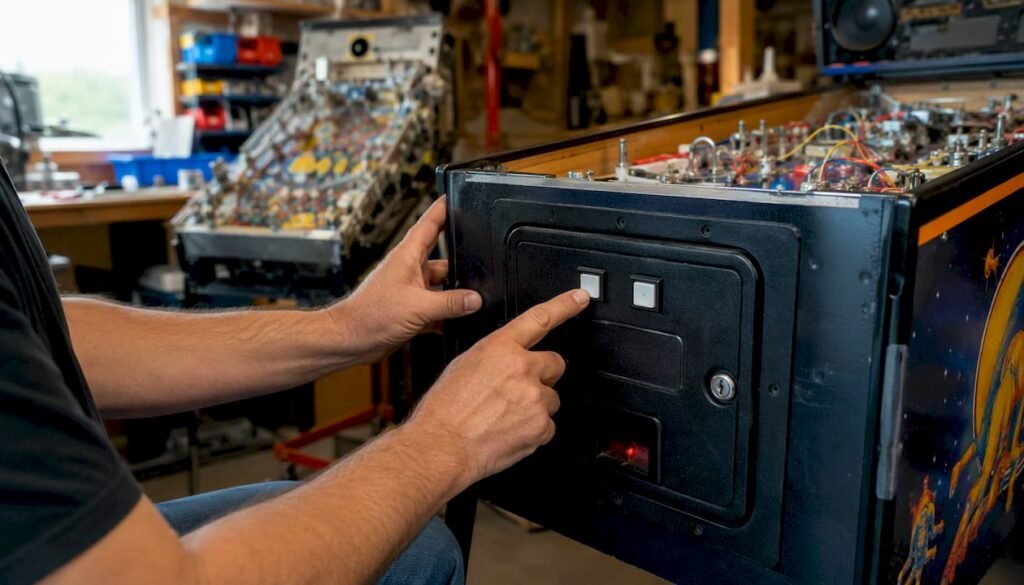
Before you hand over a dollar, run the machine’s built-in diagnostics, inspect the battery area for corrosion, and request documented test logs — those three steps alone separate a sound investment from an expensive surprise. For most collectors, home buyers, and commercial operators, a professionally refurbished machine from a vetted source like Premiumpinballs is the clearest path to ownership without regret.
Your three immediate actions:
- Power the machine on, enter the diagnostic menu, and run switch, coil, and lamp tests before negotiating price.
- Inspect the battery area on the MPU board for any sign of leakage or corrosion — this is the single most expensive hidden defect.
- Request video proof of a full boot cycle, diagnostic run, and multiball feature demo, plus a written refurbishment checklist with before/after photos.
Premiumpinballs offers certified refurbished inventory with documented inspection reports — request their 2026 refurbishment checklist before you commit to any purchase.
Key Takeaways
The single most important move any buyer can make is running diagnostics and requesting documented proof before purchase — a refurbished machine with verified test logs and a functional warranty is worth more than a lower asking price with no paper trail.
| Point | Details |
|---|---|
| Run diagnostics first | Enter the service menu and test switches, coils, and lamps before negotiating any price. |
| Inspect the battery area | MPU board corrosion is the costliest hidden defect; walk away if leakage is present. |
| Calculate landed cost | Add freight, crating, insurance, and immediate parts to the asking price before comparing options. |
| Demand documentation | Request service records, test logs, and before/after photos from any seller claiming professional refurbishment. |
| Premiumpinballs as your source | Certified refurbished inventory with documented inspections, both keys, and limited functional warranties — contact them to verify current availability. |
Table of Contents
- What are the best restoration tips for pinball machine buyers?
- How do you run diagnostics and interpret the results?
- What does professional refurbishment actually include?
- How do you value a refurbished or used pinball machine?
- What should you plan for shipping and installation?
- What warranty and return terms should you expect?
- Which buying channel is right for you?
- Premiumpinballs makes certified refurbishment straightforward
- Why professional refurbishment wins for most buyers
- Sources
What are the best restoration tips for pinball machine buyers?
A disciplined inspection follows a clear outside-to-inside sequence. Start at the cabinet before you ever flip a flipper.
Cabinet, legs, glass, and backbox:
- Check all four legs for bends, stripped bolts, or missing levelers.
- Inspect the cabinet sides for water damage, swelling, or delamination — cosmetic scratches matter far less than structural damage.
- Confirm the backbox sits square and latches securely; a misaligned hinge suggests a rough move or a drop.
- Examine the playfield glass for cracks and confirm it slides out cleanly.
Playfield condition — the highest-stakes area:
- Look for clearcoat wear under the left orbit, right ramp, and pop bumper cluster, where balls travel most.
- Check for lifted inserts (the colored plastic windows in the playfield surface) — lifting means moisture got in, and re-gluing is a skilled repair.
- Inspect plastics for cracks, especially the ramp entrances and wireform guides.
Mechanical checks:
- Work each flipper by hand. There should be minimal side-to-side slop; a loose flipper shaft signals worn bushings.
- Squeeze every rubber ring — brittle or flat rubbers need immediate replacement.
- Inspect the balls for pitting or rust; a pitted ball damages playfield clearcoat quickly.
Electronics and service areas:
- Open the coin door and check the MPU board’s battery holder for any brown or green residue. Battery leakage and board corrosion are among the costliest hidden defects a buyer can inherit.
- Confirm both the coin door key and the backglass key are present. Missing keys mean drilling or replacing locks later — an avoidable hassle that sellers often overlook mentioning.
- Visually scan the power supply board for burned components or bulging capacitors.
Transport readiness:
- Ask whether the head folds or disconnects and whether the seller will assist with leg removal before pickup.
Pro Tip: For remote purchases, photograph the battery area, the underside of the playfield, every ramp connection, and the coin door interior. Those four angles reveal the problems most sellers skip in their listing photos.
How do you run diagnostics and interpret the results?
Always run diagnostics before buying — intermittent issues that hide during casual play surface reliably in system testing. A machine that plays fine for five minutes can still carry a failing switch matrix or a coil drawing excess current.
The diagnostic flow on most solid-state machines works like this: power on and watch the boot sequence for error codes displayed before attract mode begins. Any code logged at boot is a problem the machine already knows about. From there, enter the service menu (typically via the coin door buttons) and run the switch test — press each target, bumper, and rollover in sequence and confirm each registers. A switch that doesn’t register during play will kill scoring and multiball logic.
The lamp test cycles every bulb or LED on the playfield and backglass. Dark segments on a DMD (dot matrix display) or dead lamps in a backglass are cosmetic issues on their own, but a cluster of dead lamps in one zone can point to a driver board problem. The coil test fires each solenoid individually; listen for a clean, sharp snap. A weak or sluggish coil draw suggests a failing transistor on the driver board, not just a worn coil.
Common flags to know: a “stuck switch” error means a switch is registering as always-closed, which can lock the machine in a loop. An “intermittent coil” flag during testing warrants a technician’s confirmation before purchase.
Pro Tip: Ask the seller for four short video clips: the full boot cycle, the switch test in progress, the lamp test, and a live multiball or main feature demo. A seller who refuses any of these clips is telling you something important.
What does professional refurbishment actually include?
Professional refurbishment is more than cosmetics — it restores reliability and serviceability in ways a fresh coat of wax and new rubbers alone cannot. Here is what a genuine refurbishment covers:
- Electronics inspection and board work — MPU, power supply, and driver boards are inspected for corrosion, cold solder joints, and failing capacitors. Boards are recapped or repaired as needed.
- Flipper calibration — flipper mechanisms are disassembled, worn parts replaced, and end-of-stroke switches adjusted for correct power and response.
- Rubber and plastic replacement — every rubber ring is replaced with a fresh set; cracked plastics are sourced and swapped.
- Playfield cleaning and touch-ups — the playfield is cleaned, waxed, and minor clearcoat wear is addressed. Lifted inserts are re-glued.
- Wiring inspection and repair — connectors are checked for heat damage, broken pins are re-pinned, and any burned wiring is replaced.
- Bulb and coil replacement — failing coils and burned bulbs (or LED conversions) are replaced and tested through the diagnostic menu.
- Full functional verification — the machine plays through a complete game cycle, all features are confirmed working, and a test log is generated.
A properly refurbished machine should come with its original manual, both sets of keys, extra balls, and a written service record. Insist on service history, test logs, and before/after photos — any refurbisher who cannot supply these is offering a cosmetic refresh, not a true restoration. Expect a short-term functional warranty (typically 30–90 days) covering electronics and mechanical assemblies; cosmetic coverage is generally limited. Learn more about what refurbished means in pinball before you evaluate any seller’s claims.
How do you value a refurbished or used pinball machine?
Price is driven by five factors: model desirability, condition grade, depth of refurbishment, parts availability, and included accessories. A title with strong collector demand — think Addams Family or Attack From Mars — commands a premium regardless of condition tier.
Typical U.S. price ranges (market guidance, not guarantees):
Source: Game Room Shop buyer FAQ. Use these as benchmarks, not ceilings.
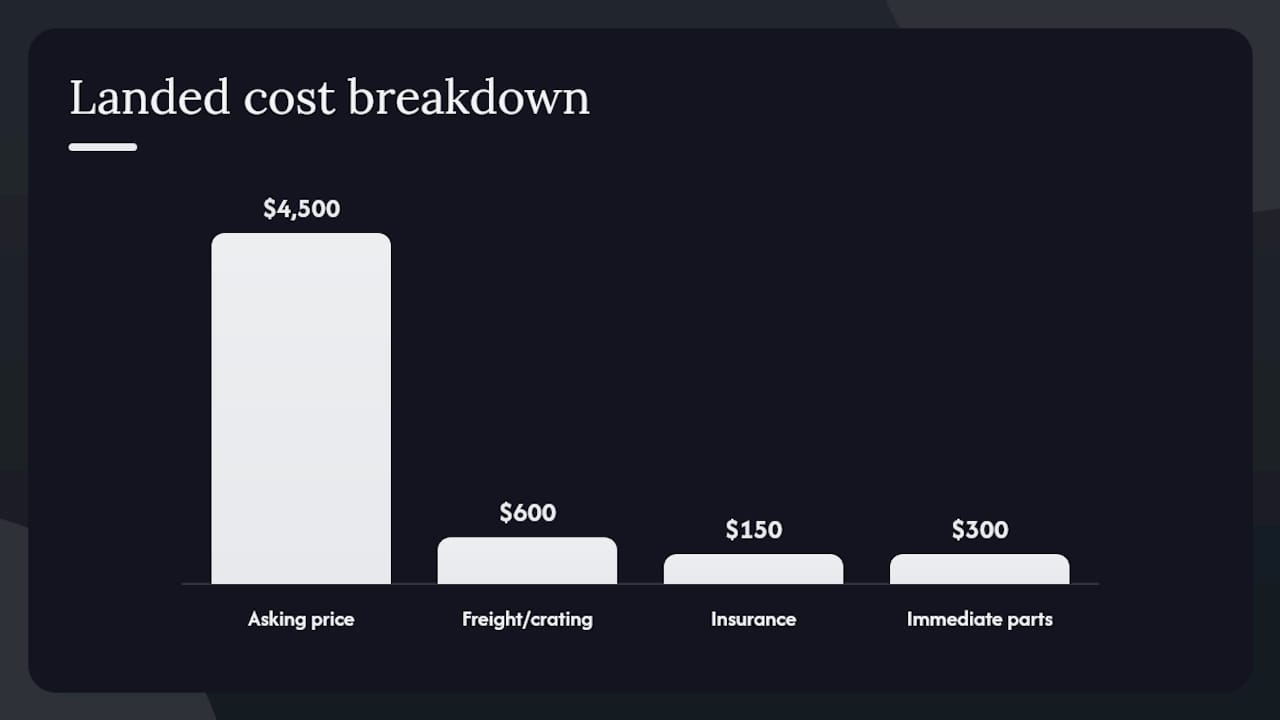
Your landed cost formula: asking price + freight/crating + insurance in transit + immediate maintenance (rubbers, bulbs, any parts the seller disclosed as worn). A $4,500 used machine with $600 freight, $150 insurance, and $300 in immediate parts lands at $5,550 — often within range of a refurbished unit that needs nothing on arrival. Explore pinball pricing factors to sharpen your estimate.
Red flags that reduce value:
- Any sign of battery leakage on the MPU board
- Water damage or swelling on the cabinet bottom
- Missing rare plastics or discontinued ramp assemblies
- No keys, no manual, and no service history
What should you plan for shipping and installation?
Measure before you commit. A standard full-size pinball machine stands roughly 76 inches tall with the head up, 28 inches wide, and 55 inches deep, and weighs 250–300 lbs. Confirm your doorways (minimum 32 inches clear), any stairwells, and your floor’s load capacity before the machine ships.
- Seller-arranged delivery is convenient but verify the carrier has pinball experience — standard freight carriers treat machines as appliances and damage rates are higher.
- Specialized arcade movers cost more but arrive with proper dollies, padding, and experience folding heads and removing legs.
- Local pickup saves freight costs but requires your own vehicle, a loading ramp, and at least two people.
Always request that the seller remove the legs and fold or disconnect the head before loading. Detailed guidance on safe moves, leg removal, and transport prep can prevent the most common transit damage. For any shipment over 200 miles, insist on crating and declare the full replacement value for insurance — freight damage claims on uncrated machines are routinely denied.
What warranty and return terms should you expect?
Reputable refurbishers offer a limited functional warranty — typically 30–90 days on electronics and mechanical assemblies — and a defined return window if the machine was materially misrepresented. Private sellers offer none of this, which is the core risk of that channel.
Walk away if the seller:
- Refuses to run diagnostics or power the machine on during inspection
- Cannot produce both sets of keys
- Gives vague or contradictory repair history (“it was fixed a while back”)
- Declines to provide photos of the battery area or underside of the playfield
- Pressures you to close the deal before you’ve completed your checks
Documentation to request before purchase:
- Written service record or technician’s notes
- Diagnostic test log (screenshot or printed report)
- Before/after photos of the playfield and boards
- Proof of rubber and plastic replacement
- Both keys (coin door and backglass) confirmed present
Community forums like Pinside surface the practical questions buyers often forget — use them to build your personal inspection script, then verify every claim with the documentation above.
Which buying channel is right for you?
| Channel | Condition & Reliability | Warranty & Support | Best For |
|---|---|---|---|
| Dealer / refurbisher | Verified, documented | Limited functional warranty, return window | Operators, collectors wanting confidence |
| Private seller | Variable, undocumented | None | Experienced buyers, budget-first shoppers |
| Auction | Unknown, as-is | None | Experienced buyers comfortable with risk |
Commercial operators should prioritize reliability and serviceability over lowest price — a machine that goes dark in a venue costs revenue every hour it sits idle, not just the repair bill. For venues, a refurbished unit with documented boards and a warranty is almost always the lower total cost of ownership. Read more on choosing pinball for arcades to match machine specs to your venue’s demands.
For private-seller purchases, ask: How long have you owned it? What has been repaired and when? Does it have all original keys? Has it ever had water exposure? A seller who answers these fluently and offers to run diagnostics on the spot is a seller worth trusting.
Contact Premiumpinballs directly to review certified refurbished inventory with documented inspection reports and defined warranty terms.
Premiumpinballs makes certified refurbishment straightforward
Buying a pinball machine should feel like acquiring a prestige piece, not rolling the dice on an unknown repair bill. Premiumpinballs offers certified refurbished machines backed by trained technician inspections, documented test logs, and a limited functional warranty — so you know exactly what you’re getting before it arrives at your door.
Every machine in the Premiumpinballs inventory ships with both sets of keys, a verified service record, and shipping and installation support tailored to your location. Whether you’re outfitting a commercial venue with arcade-grade machines or adding a statement piece to your home game room, the inventory is curated for buyers who expect reliability alongside prestige. Browse the certified refurbished selection at Premiumpinballs or reach out directly to request a machine-specific inspection report and current availability.
Why professional refurbishment wins for most buyers
The conventional wisdom says “buy used and save money.” In practice, that calculus breaks down the moment you factor in a single board repair, a set of replacement plastics, and a technician’s hourly rate. For a commercial operator, one week of downtime on a revenue-generating machine can erase the entire price difference between a private-sale bargain and a professionally refurbished unit.
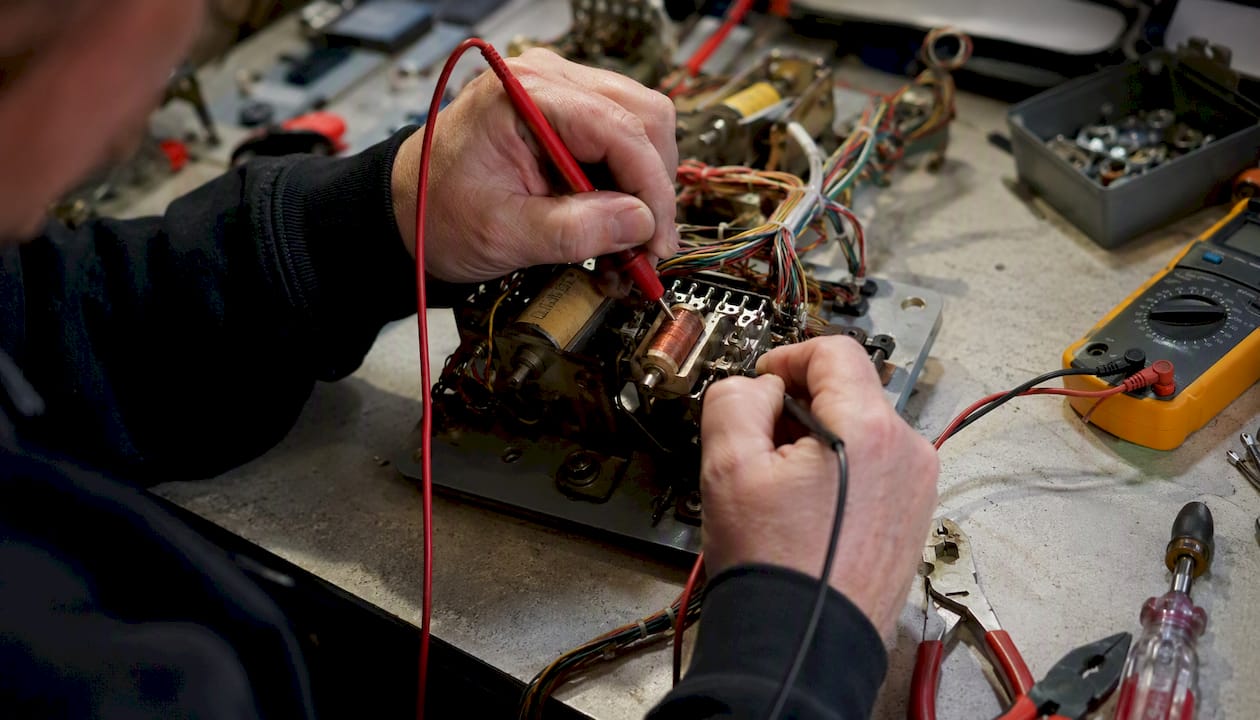
What most buyers underestimate is the hidden cost of uncertainty. A machine with no service history forces you to audit every system yourself or pay someone to do it. A professionally refurbished machine from a source like Premiumpinballs arrives with that audit already done, documented, and warranted. The advantages of refurbished machines go beyond condition — they include the confidence to put the machine into service immediately, without a diagnostic session as your first ownership experience.
Sources
These sources informed the inspection, diagnostics, and valuation guidance throughout this article. Use them to verify seller claims and build your own pre-purchase checklist.
- What are some questions to ask when buying a pinball machine? – Retro Only
- Thinksofgames
- Buy a used pinball machine: guide and advice – PinballMag
- Used Pinball Machine Buying Guide For First-Time Buyers – MTG Card Makers
- Questions to Ask When Buying a Pinball Machine – Pinside forum
Whenever possible, prefer seller-supplied test logs and in-person verification over listing photos alone. A machine that passes a live diagnostic session in front of you is worth far more than one that looks perfect in a gallery of curated images.